Trine Vingegaard is the shorthand many fans use for Trine Marie Hansen, and her name keeps surfacing for a reason. She is Jonas Vingegaard’s wife, but also a former rower and a sports professional in her own right, which makes her perspective more grounded than the usual celebrity side note. For readers who want to understand the human side of road cycling, that combination matters.
This article breaks down who she is, why she appears so often in Jonas’s story, and what her role says about life inside a modern WorldTour schedule, the top tier of professional road racing. I’ll also translate that into something useful for everyday cyclists, because the same themes of recovery, support, and workload show up far beyond the pro peloton.The short version of why Trine matters in Jonas Vingegaard’s story
- She is Jonas Vingegaard’s wife and a former rower with her own professional background.
- Her name appears often because family life and Tour-level preparation collide.
- Public comments around training camps sparked a wider discussion about burnout and recovery.
- For road cyclists, the bigger lesson is that performance depends on more than watts and workload.
- The useful takeaway is practical: protect recovery, schedule life around training, and respect the limits of volume.
Who Trine Hansen is and why her name keeps appearing around Jonas Vingegaard
What I find useful about this topic is that it clears up a simple confusion: this is not a random side figure attached to a famous rider. Vogue described Hansen as a former rower who works in talent management, and that sporting background matters because it gives her a much sharper view of what elite training really costs.
They met when Vingegaard rode for ColoQuick in Denmark, where she worked on the marketing side, so the connection was built inside the sport rather than on the edges of it. Their relationship is often discussed because it crosses the line between private life and sporting structure.
For a road-cycling audience, the important point is simple: the people closest to a rider are often part of the performance ecosystem, even if they are not in the race convoy. And that leads directly to the real reason her name draws attention: what she says about the workload around the sport.
Why her comments hit a nerve in elite road cycling
Cyclingnews reported that Trine Hansen’s criticism centered on altitude camps and time away from family, and that is exactly why the reaction was so strong. In pro cycling, an altitude camp is a training block spent at elevation to boost aerobic adaptation, but it also removes the rider from normal home life for weeks at a time. That trade-off is easy to miss if you only watch race broadcasts.
Her comments touched a nerve because they exposed the part of the sport fans usually ignore: the cost of keeping a Tour contender ready for July. A rider does not simply turn up fresh. He has to move through training blocks, recon rides, media duties, recovery days, and travel. If any one of those parts gets too heavy, the pressure spreads quickly.
| What the discussion exposed | Why it matters in road cycling | What riders and families learn |
|---|---|---|
| Altitude camps | Useful for adaptation, but demanding on home life | Volume only works when recovery is protected |
| Long race blocks | Grand Tours and stage races stretch a rider’s attention for weeks | Time management matters as much as fitness |
| Public pressure | Private concerns become team-story headlines fast | Boundaries are part of performance |
How family life fits around a Grand Tour calendar
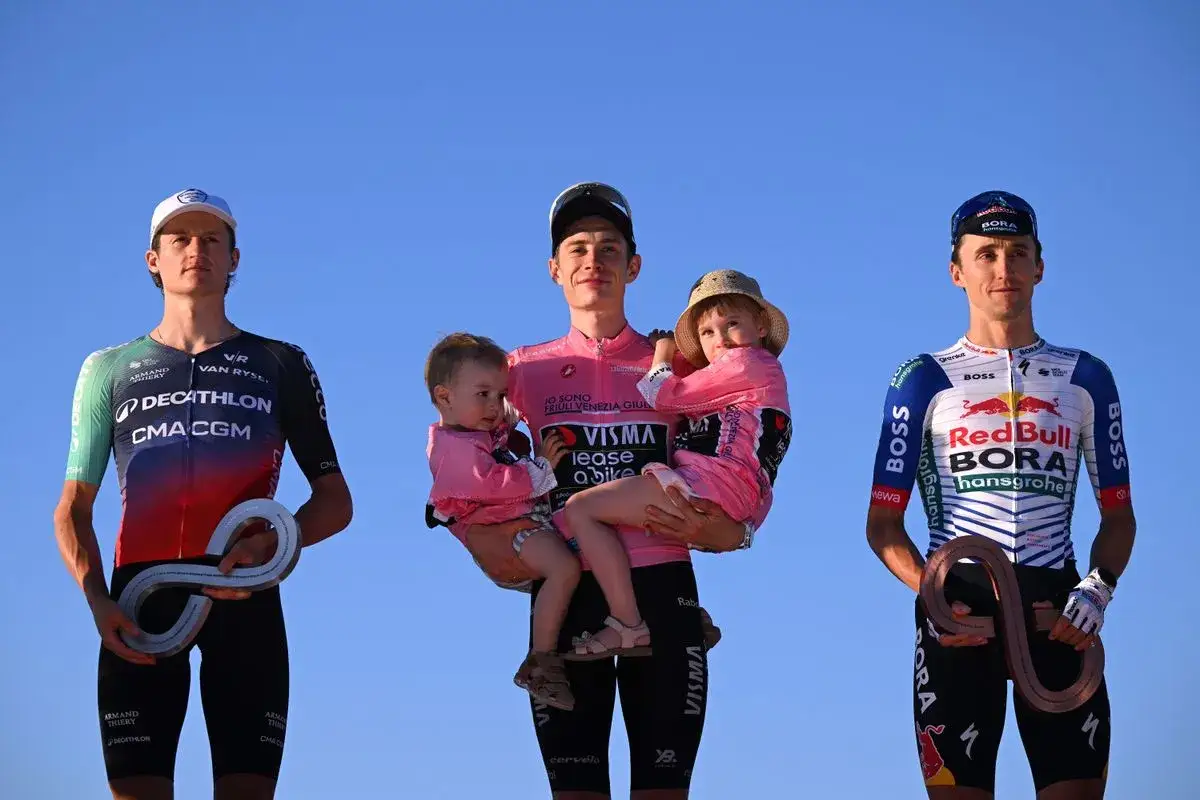
The easiest mistake is to imagine that a top rider’s season is just race day after race day. It is not. A Tour de France run means 21 stages across three weeks, and the preparation behind it is built around training blocks, recovery windows, team camps, and the kind of travel that makes a normal home routine hard to maintain.That is why family life becomes part of the performance question, not a distraction from it. A parent who is away for altitude training or race recon has less time for the ordinary reset that keeps life stable. For most athletes, that means the support system has to do three jobs at once: protect the athlete, keep the household running, and preserve enough normality that the rider can switch off when he is home.
- Training camps build fitness, but they compress family time into smaller windows.
- Travel adds fatigue that is not always visible in race results.
- Recovery is easier to plan on paper than to protect in real life.
- Routine matters because even top riders perform better when home still feels like home.
For amateur cyclists in the United States, the comparison is smaller but familiar. You may not be living out of a team hotel, yet the same pattern shows up whenever training volume starts competing with work, parenting, or travel. The difference is scale, not principle. And once that becomes clear, Trine’s role stops looking like celebrity gossip and starts looking like a case study in sustainability.
What makes her more than a supporting character
The reason the Trine story works is that she is not framed like a passive spouse waiting on results. She understands sport from the inside, and that changes the quality of the conversation. When someone has spent years around competition, they are usually better at separating real strain from public noise, and better at recognizing when a training plan has crossed from hard into careless.
That matters in a sport like road cycling, where image and reality often drift apart. Fans see podiums, race interviews, and polished team graphics. What they do not see is the constant negotiation behind the scenes: who travels when, how much altitude work is enough, when a rider needs to say no, and how much emotional bandwidth is left after a long block of racing. Trine’s perspective gives that hidden side a voice.
It also explains why her comments resonate beyond one family. A modern pro rider is not just an engine on wheels. He is part of a household, part of a team, and part of a schedule that can swallow the year if nobody pushes back. That is where experienced partners often matter most: they are the people most likely to notice when the balance starts to slip.
If I had to reduce the whole thing to one sentence, it would be this: her value in the story is not that she is close to the rider, but that she understands the sport well enough to challenge it.
What everyday cyclists can borrow from the Vingegaard example
This is the part I think readers can use immediately. Most riders will never need a WorldTour support crew, but they do need a structure that does not collapse the rest of life. The Vingegaard example is useful precisely because it shows what happens when performance is treated as a whole-system problem instead of a fitness-only problem.
| Pro lesson | Amateur version | Why it works |
|---|---|---|
| Protect recovery like training | Schedule rest days before you feel broken | Fitness gains happen when stress is absorbed |
| Respect family time | Block out predictable non-training windows | Consistency beats heroic overreaching |
| Use hard blocks strategically | Focus on one goal block at a time | Trying to peak for everything usually blunts everything |
| Listen for fatigue signals | Watch for sleep loss, irritability, and flat legs | Those are often earlier warnings than power numbers |
- Do not copy a pro’s workload without copying the recovery that supports it.
- Do not assume more training always means better form.
- Do build a support network that can tell you when you are chasing too much.
- Do treat the calendar as part of training, not as an afterthought.
In practical terms, that is the most adult lesson in the whole story: the best plan is the one you can actually repeat without breaking your life around it.
The part most fans miss when they focus only on race results
As of 2026, the most useful way to read the story around Jonas Vingegaard is not as a family sidebar but as part of the performance model. That is why the name Trine keeps coming up. She represents the part of the sport that lives behind the camera: the pressure of long away blocks, the need for honest communication, and the reality that a rider performs best when the rest of life is not in constant conflict with the race calendar.
I think that is a healthier way to read the story than turning it into gossip or team drama. When the headlines settle, what remains is a very ordinary truth wrapped in an extraordinary sport: elite results usually depend on stable routines, clear boundaries, and a home base that can absorb the strain of ambition.
For readers in the United States, the broader takeaway is easy to apply. Whether you race, ride gravel, or train before work, the biggest performance gains often come from the boring things no one posts: sleep, structure, recovery, and a home life that does not get sacrificed every time the training plan gets ambitious. That is the real lesson hidden in the conversation around Trine Hansen and Jonas Vingegaard.