Categorized climbs are the road-race shorthand for how hard an ascent really is, and they affect everything from pacing to tactics to mountain points. I’m going to break down how the labels work, what the common categories usually mean in practice, and how I’d use them to ride, train, and plan for climb-heavy road events.
The main things to know about climb categories
- Climb categories are a race shorthand, not a universal scientific formula.
- Length, gradient, elevation gain, road quality, and stage position all influence the label.
- Current race route books show Cat 4 climbs as short as 0.7 km at 9.7% and HC climbs up to 17.1 km at 7.3%.
- The same category can feel very different depending on whether it appears early or late in the stage.
- For training, short categories call for punchy repeats, while Cat 2, Cat 1, and HC climbs reward longer threshold work and better fueling.
What climb categories are really telling you
In road racing, a climb category does three jobs at once: it ranks difficulty, helps decide where mountain points are awarded, and tells riders where the race may break apart. A Category 4 rise is usually a warning shot; a Category 1 or HC climb is often a genuine selection point. I treat the label as a clue, not a verdict, because the real question is always how that climb fits into the stage around it.
That matters in the U.S. as much as anywhere else. Whether you are looking at a local road race, a gran fondo, or a WorldTour route profile, the category is there to help you estimate effort and tactics before the road tips up. The next step is understanding how that label gets chosen.
How organizers assign a category
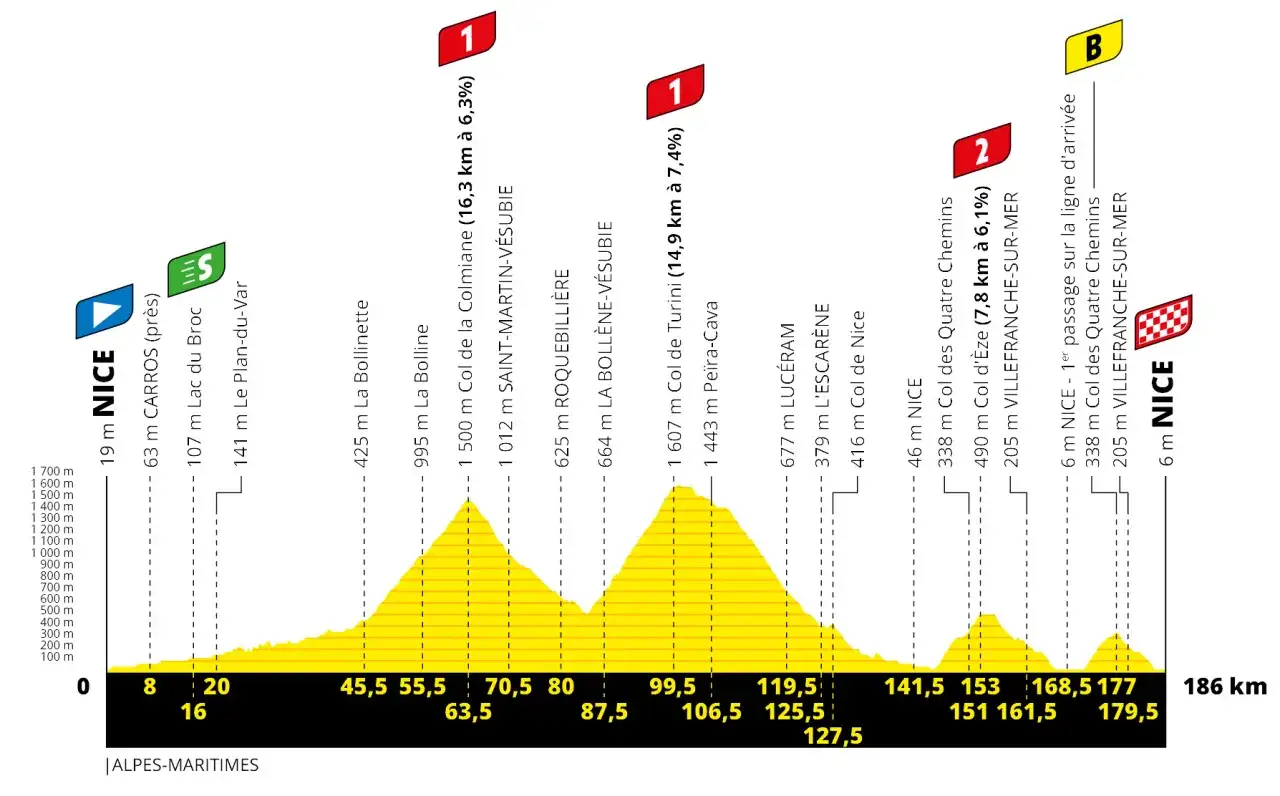
There is no single universal formula across every race. Organizers blend length, average gradient, total elevation gain, the steepest ramps, road quality, and where the climb appears in the stage. The same road can be labeled differently if it comes early or late, because race context changes the difficulty. In current 2026 Tour de France route books, for example, a Cat 4 climb can be as short as 0.7 km at 9.7%, while an HC climb can stretch to 17.1 km at 7.3%.That context matters enough that even digital platforms handle it differently. Strava, for example, uses an objective segment formula inside its own system, while race organizers can apply a more tactical lens. That difference is useful: race categories are contextual, while app categories are algorithmic. Once you see that, the table of climb types starts to make a lot more sense.
What each category usually means in practice
These are practical race signals, not fixed global rules. I like to think of them as the rough shape of the effort a rider is about to face.
| Category | Typical shape | Current route example | What it usually means |
|---|---|---|---|
| Category 4 | Short, punchy climb, often 1 to 3 km | 0.7 km at 9.7% | Good for a tempo change, a small attack, or testing tired legs |
| Category 3 | Moderate climb, often 2 to 8 km | 3 km at 6.8% | Enough to split weaker riders if the pace is steady or repeated |
| Category 2 | Solid test, often 4 to 10 km | 4.8 km at 7.2% | The first climb where the race can really start shedding riders |
| Category 1 | Major mountain, often 7 to 14 km or more | 12 km at 6.5% | A serious effort that can decide stage results and GC gaps |
| HC | Long, hard mountain, often 13 km+ | 17.1 km at 7.3% | The hardest category, usually reserved for decisive mountain days |
The same number can hide very different climbs. A Cat 4 wall at 9% feels nothing like a rolling Cat 4 that comes after a flat run-in, and a Cat 1 climb can be short but violent or long and grinding. That is why the label helps, but the stage profile still matters more. The next question is how to ride each type without wasting energy before the real selection point.
How I pace and race each type of climb
Cat 4 and Cat 3 climbs
My goal here is position, not heroics. I want to be near the front before the base, keep the first minute controlled, and avoid chasing every tiny surge. On a climb that lasts only a few minutes, wasted matches matter more than raw fitness. If the road kicks up after a fast lead-in, the riders who arrive already boxed in usually spend more energy than the riders who are simply well placed.
Cat 2 and Cat 1 climbs
Here I ride by rhythm. Threshold is the hardest effort you can hold for a long time, so I want a steady cadence, clean fueling, and no panic at the first steep ramp. If the climb lasts 10 to 20 minutes, a single bad surge can cost more than a gear choice. For many amateur riders, a compact or sub-compact setup with a 30 to 34 tooth largest cog is a sensible baseline for this terrain, especially if the course has repeated climbing.
Read Also: Pogačar's Tour de France Dominance - What Amateurs Can Learn
HC climbs
On longer mountains, the race is about pacing, feeding, and not bleeding time before the summit. I think in blocks of 10 minutes, drink early, and avoid the ego trap of following every move. For many riders, the climb starts before the bottom because position and energy management decide how much they pay when the road kicks up. That is also where climbing skill and gear choice start to overlap with training.
How to train for climbs that actually matter
When I train for climbs, I match the workout to the effort length I expect on race day. That keeps the work specific instead of just hard.
- Short, punchy climbs: 6 to 10 repeats of 2 to 4 minutes hard with equal recovery. This builds acceleration and repeatability for Cat 4 and Cat 3 terrain.
- Medium climbs: 3 to 5 repeats of 8 to 12 minutes at threshold with 3 to 5 minutes easy between. Threshold is the highest effort you can sustain for roughly an hour.
- Long climbs: 2 to 3 blocks of 15 to 20 minutes at sweet spot or threshold, plus longer endurance rides. Sweet spot means just below threshold, where the work is hard but still sustainable.
- Fueling practice: rehearse eating and drinking every 20 to 30 minutes on rides longer than 90 minutes, because the biggest mistake on real mountain days is under-fueling before the climb starts.
If your local roads in the U.S. are rolling rather than Alpine, use repeated climbs or trainer intervals to simulate fatigue. One long hill is useful; repeated hills teach race behavior. That said, even strong training does not help much if you misread the climb itself.
The mistakes that make riders misread a climb
The most common error is judging the climb only by average gradient. A 6% climb over 10 km is not the same as a 6% climb with repeated ramps at 12% or a tailwind on the approach. Stage position changes the cost too: a Cat 3 in the first hour is not the same animal as a Cat 3 after 170 km of racing.
- Ignoring where the climb sits in the stage.
- Assuming a low category means an easy effort.
- Overreacting to the first attack and burning matches too early.
- Forgetting that heat, wind, altitude, and road surface change how hard a climb feels.
- Focusing on the summit and ignoring the run-in or descent that follows.
A climb is a race scenario, not just a slope. The label tells you something useful, but it does not tell you everything. That is why the smartest riders read the road with the category, not instead of it.
Read the road more accurately than the label
My checklist is simple: check the category, check the gradient, check the climb length, and then check where it lands in the stage. If two of those four factors look harsh, I expect a much harder day than the category alone suggests. That is usually enough to separate a harmless-looking rise from the climb that actually decides the race.
- Short climb plus repeated changes of pace usually favors punch and positioning.
- Long climb plus steady gradient usually rewards pacing and aerobic durability.
- Late climb plus heat or wind usually increases attrition fast.
If you remember one thing, keep this: the category is a useful shorthand, but the race is decided by context. Once you learn to read both, categorized climbs stop being a label and start becoming a race plan.