Fast road time trials are won by riders who can hold a hard effort, stay calm in the aero position, and avoid wasting power with unnecessary spikes. The best preparation is not just “more intensity”; it is a mix of threshold work, position practice, pacing discipline, and race-specific endurance that teaches your body to produce speed when it matters. This article breaks down what actually improves time-trial performance on the road, and how I would build that work into a realistic training block.
The quickest way to get faster against the clock
- Focus first on sustainable power, because most road time trials are limited by how long you can hold a hard effort, not by one big attack.
- Build around threshold sessions like 2 x 20 minutes, 5 x 5 minutes, and longer race-pace intervals instead of random hard rides.
- Practise the aero position in training until it feels repeatable, not just fast for the first 10 minutes.
- Pace with control: start hard, settle quickly, and save your best push for the final third of the effort.
- Use equipment to support the position, but do not let gear choices replace fitness, comfort, and consistency.
- Most riders improve fastest when they keep the block simple, repeatable, and specific to the course they actually race.
What a fast time trial really asks of you
A road time trial is a very specific problem: you are producing near-maximal power for a long time while fighting air resistance on your own. That means the rider who looks strongest in a short group effort is not automatically the fastest against the clock. I want riders to think in terms of three linked demands: steady power, low drag, and controlled fatigue.
On flatter courses, aerodynamics can matter more than people expect, because speed rises and drag rises with it. On rolling courses, the challenge is slightly different: you still need to stay aero, but you also need enough muscular durability to keep pressure on the pedals after every rise, turn, or false flat. That is why good time trial training is less about “just go hard” and more about teaching your body to hold race power while staying efficient.
That balance matters even more in the United States, where local 10-mile club TTs, 20 km test events, and longer championship-style courses often mix heat, wind, and imperfect pavement. Once you see the event that way, the next step is obvious: choose workouts that build the exact kind of fatigue resistance the effort requires.The workouts that build durable race power
If I had to reduce TT prep to the few sessions that earn their place, I would keep the list short. I do not want riders living in the red all week. I want repeated work at or just around threshold, because that is what lifts the ceiling for a sustained effort and teaches pacing at the same time.
| Session | Example set | Why it helps | How I would use it |
|---|---|---|---|
| Threshold builder | 2 x 20 minutes at upper zone 4 or race pace, 10 minutes recovery, 90-100 rpm | Raises sustainable power and teaches even pressure over long blocks | Once per week in the build phase |
| Strength endurance | 4-6 x 4 minutes at 40-60 rpm in zone 3-4, seated and in the aero bars, 4 minutes recovery | Improves torque, muscle endurance, and confidence holding the TT position under load | Once per week or alternate with threshold work |
| Threshold repeats | 5 x 5 minutes with short recovery, aiming for controlled but hard execution | Builds threshold and pacing discipline without needing a huge single effort | Useful when you are time-crunched or need a cleaner quality session |
| High-intensity support | 6 x 4 minutes slightly above TT pace at 105-120 rpm, 1 minute recovery | Lifts the top end and makes race pace feel less threatening | Every 7-14 days, not all season long |
| Race simulation | 20-40 minutes continuous at target pace on similar terrain | Tests pacing, fueling, and position under conditions close to race day | Every 2-3 weeks once the block is specific |
| Endurance with aero blocks | 2-4 hours in zone 2 with 2-3 blocks of 10-20 minutes in the TT position | Makes the position sustainable and turns aero work into something routine | Weekly if your schedule allows it |
The pattern matters more than the exact menu. Long intervals are especially useful because they are “self-correcting”: if you go too hard, the second half falls apart, and that tells you the pace was wrong. Shorter efforts have their place too, but if your target is a 20- to 40-minute race, I would keep returning to sustained work that feels uncomfortable without becoming chaotic.
One practical rule I use: when a rider starts improving, the quality of the second rep should look almost as good as the first. If every session turns into a hero effort, the training is probably too hot. Once that engine is built, the next bottleneck is usually position, because speed can disappear quickly if the body cannot stay efficient on the bike.
Build an aero position you can actually hold
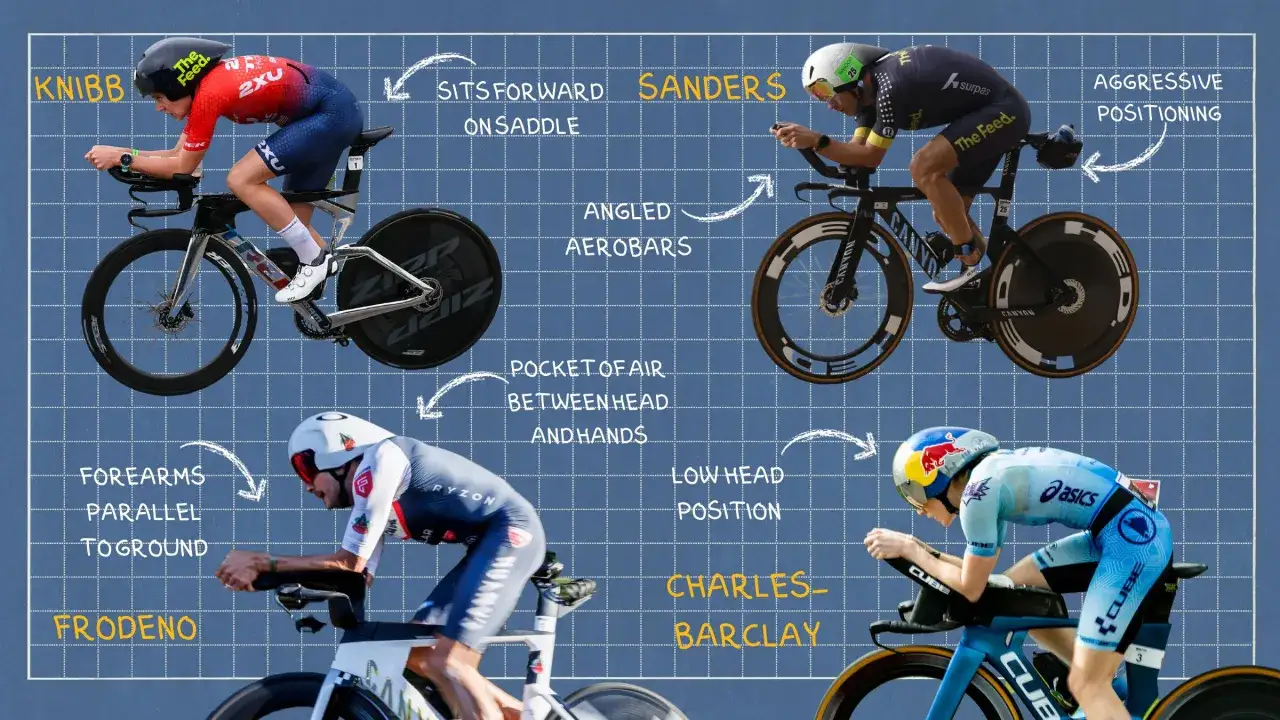
The fastest position is not the one that looks most aggressive in a photo. It is the one that stays narrow, stable, and repeatable after 10, 20, or 40 minutes of hard riding. Research on trained cyclists has shown a real trade-off between lower torso angles and physiological function, which matches what I see in practice: if the position is too low or too stretched, power drops, breathing gets tighter, and the rider starts fighting the bike.
That is why I would never separate fitness work from position work. If you only ride aero when the workout is easy, the race position will feel like a shock on the start line. Instead, build it gradually.
- Start with short blocks in the bars, then extend them to 2 x 20 minutes or a full race simulation.
- Keep the shoulders narrow and the head still enough that you are not bobbing in the wind.
- Use the core and hip flexors to support the position, not your lower back and arms.
- Adjust pad stack, reach, or saddle setback if power drops sharply or you cannot breathe naturally.
- Practise the position on normal training days, not only on key workout days.
I also like to remind riders that gear should serve the position, not hide bad positioning. An aero helmet, tight clothing, and clean bar setup help, but they do not fix a position that is too low to hold or too open to be aerodynamic. If you can hold the shape comfortably, the gear starts to matter more. If you cannot, the setup is wrong and the training will expose it quickly.
Once the position is repeatable, you can start using it to sharpen pacing, because aero work becomes much more valuable when your body no longer treats it like a survival test.
Pace the effort like a controlled attack
Most riders lose more time by pacing badly than by choosing the wrong interval set. Start too hard, and you pay for it for the rest of the race. Start too conservatively, and you never get the time back. The practical goal is not perfect sameness from start to finish; it is a hard opening, a stable middle, and a finish that rises instead of collapses.
| Course or event | How I would pace it | Common mistake |
|---|---|---|
| Under 20 minutes | Fast but controlled launch, then settle quickly into a hard, sustainable rhythm | Going out like a pursuit and fading before halfway |
| 20-40 minutes | Slightly aggressive start, steady middle, stronger final third | Riding the whole thing as if it were a 5-minute effort |
| 40+ minutes | Conservative first few minutes, then lock into race power and hold it with discipline | Saving too much early and running out of road |
| Rolling terrain | Keep pressure over crests, avoid big zeroes, and treat short rises as controlled surges | Chasing every hill with a sprint |
Power meter data helps here, but I would not use watts alone. RPE still matters, especially in heat, wind, or on a technical course where numbers can lag behind reality. I also want riders to rehearse the opening minutes in training: not full race efforts every week, but enough hard starts that the race does not feel unfamiliar.
For most amateur road TTs, a 20-30 minute warm-up with a few short openers is enough to feel ready without arriving cooked. That warm-up should leave you alert, not exhausted. If you are shivering, flat, or mentally dull at the start, the pacing problem began before the gun went off.
When pacing and position start to work together, the next step is organising the block so those gains actually stack instead of competing with fatigue.
A simple 6-week block that fits most riders
I like a short, focused block for time trial preparation because it keeps the work specific and manageable. Six weeks is enough to sharpen many riders if the plan is honest about recovery. Longer blocks can work too, but only if the same ideas stay in place: threshold focus, aero practice, and enough freshness to absorb the training.
- Weeks 1-2: establish training zones, add one threshold session and one aero endurance ride each week, and test how long you can stay comfortable in the position.
- Weeks 3-4: extend the main intervals, add low-cadence strength work, and start doing longer race-pace blocks on similar terrain.
- Week 5: sharpen with one race simulation, one shorter high-intensity session, and one easier endurance ride that still includes aero time.
- Week 6: reduce volume by roughly 30-40%, keep a few short openers, and focus on freshness, sleep, and clean execution.
If you only have five to seven hours a week, I would still use the same structure, just with shorter endurance rides and fewer extras. The trap is trying to cram in every possible method and ending up too flat to absorb any of them. Two quality days separated by recovery, one longer ride, and one or two easy rides is usually enough to make meaningful progress.
I also like to keep notes during the block: how long the aero position feels stable, what cadence feels most natural, whether the first five minutes are too hot, and how the last ten minutes hold up. That kind of feedback is far more useful than generic “felt good” comments. Once you see the pattern, the final gains come from avoiding the mistakes that keep riders stuck.
The mistakes that cost the most time
Most amateur riders do not lose time because they lack motivation. They lose it because the block is messy. The biggest errors are usually the same.
- They do too many hard workouts and arrive stale for the sessions that matter.
- They spend too little time in the actual TT position, so race day feels unfamiliar.
- They start too hard and turn a controlled effort into damage control.
- They chase equipment upgrades before they have a stable position and pacing plan.
- They ignore cooling and fueling, especially in hot American summer races.
That last point matters more than many riders admit. If a race is long enough, being underfed or overheated can erase the benefit of a much more expensive setup. I would rather see a rider show up with a clean position, a practiced pace plan, and proper fueling than with a perfect wheelset and no control over the effort.
The good news is that these mistakes are fixable. You do not need a complicated system to get faster. You need a handful of repeatable habits, and you need to practise them until they feel ordinary.
If you only have a few hours a week, start here
When time is limited, I would keep the hierarchy simple: one threshold session, one aero-position session, and one longer endurance ride each week. If you can add a second quality workout, make it either low-cadence strength endurance or a short high-intensity session, depending on whether your weakness is sustained pressure or late-race top-end. That is enough for most riders to see real progress without turning the week into a recovery problem.
The biggest return usually comes from tightening the basics: hold a position you can repeat, ride the correct pace, and make the hard work specific to the event. That is the core of effective time trial training on the road, and it is also the simplest way to stop wasting energy on training that feels impressive but does not move the clock. If you want the fastest next step, I would start by making your next threshold workout longer, your next aero block more honest, and your next race start slightly more controlled.