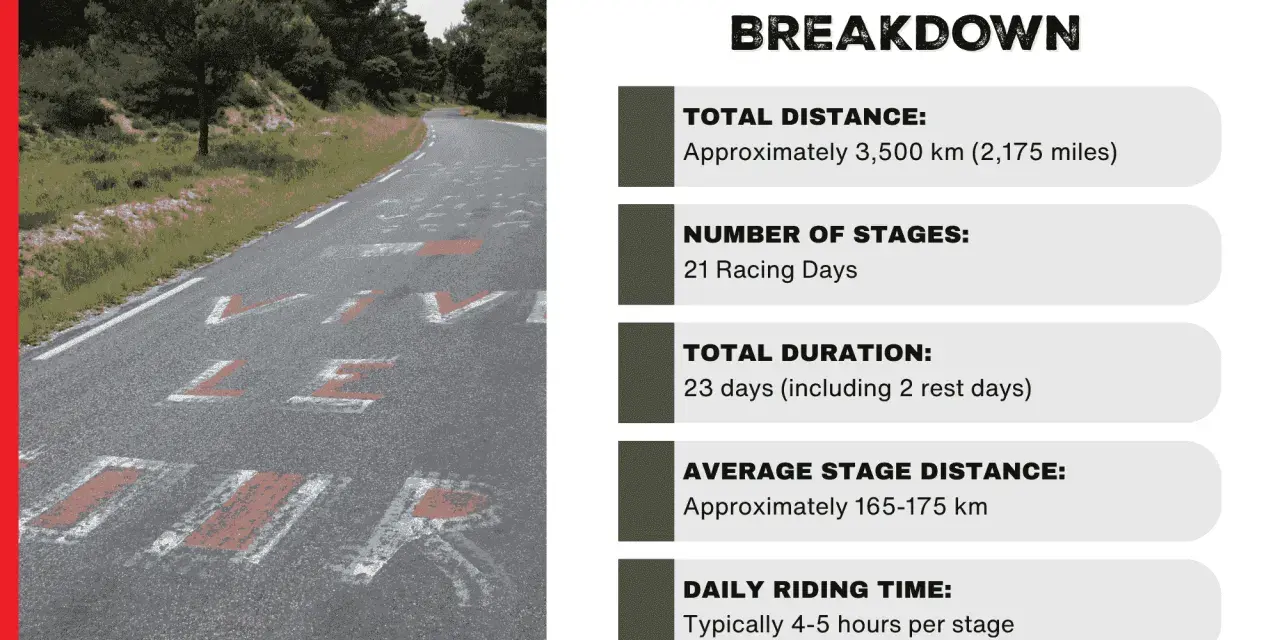
That matters because distance alone can be misleading. A 180 km flat stage and a 180 km mountain stage ask for very different pacing, fueling, and recovery, which is why I always read stage length together with the profile.
The Tour’s daily distance usually lands near a long ride, but the workload changes fast.
- The 2026 route totals 3,298.6 km across 21 stages, or about 2,050 miles.
- The overall average comes out to about 157 km per stage, roughly 98 miles.
- Road stages are longer on average, closer to 171 km, or about 106 miles.
- Time trials are much shorter, which pulls the average down and changes the racing style completely.
- Elevation gain, weather, and stage design matter as much as distance when judging difficulty.
The daily distance is a range, not a fixed number
If you want the simplest practical answer, most Tour road stages fall somewhere between 150 and 200 km, or about 93 to 124 miles. That is long enough to require serious endurance, but the race also includes very short efforts, especially team and individual time trials, where the distance can drop below 30 km and the character of the day changes completely.
I think the mistake people make is treating mileage as a proxy for difficulty. In the Tour, it is only one layer. Stage design changes the pace, the amount of climbing, the time spent on the front, and how much recovery a rider needs for the next day. That is why stage type matters more than the headline number, and it is the next thing I always check.
How stage type changes the mileage
Once you compare stage types side by side, the pattern becomes obvious. The race uses distance very differently depending on whether the goal is sprint drama, climbing, or a pure race against the clock.| Stage type | Typical daily distance | What it usually means | How I read it |
|---|---|---|---|
| Flat stage | 170-210 km, 106-131 miles | High speed, sprint finish likely, long team control | Long on paper, but often steadier than a mountain day |
| Hilly stage | 160-200 km, 99-124 miles | Rolling terrain, breakaways, repeated short climbs | Distance matters less than the constant pressure |
| Mountain stage | 120-190 km, 75-118 miles | Lower average speed, heavy climbing, late race damage | A shorter number can still mean a brutal day |
| Individual time trial | 10-35 km, 6-22 miles | Solo effort, no drafting, pure clock-based racing | Short, specialized, and very intense |
| Team time trial | 15-30 km, 9-19 miles | Coordinated pacing, smooth effort, little recovery during the stage | The distance is short, but the intensity is still high |
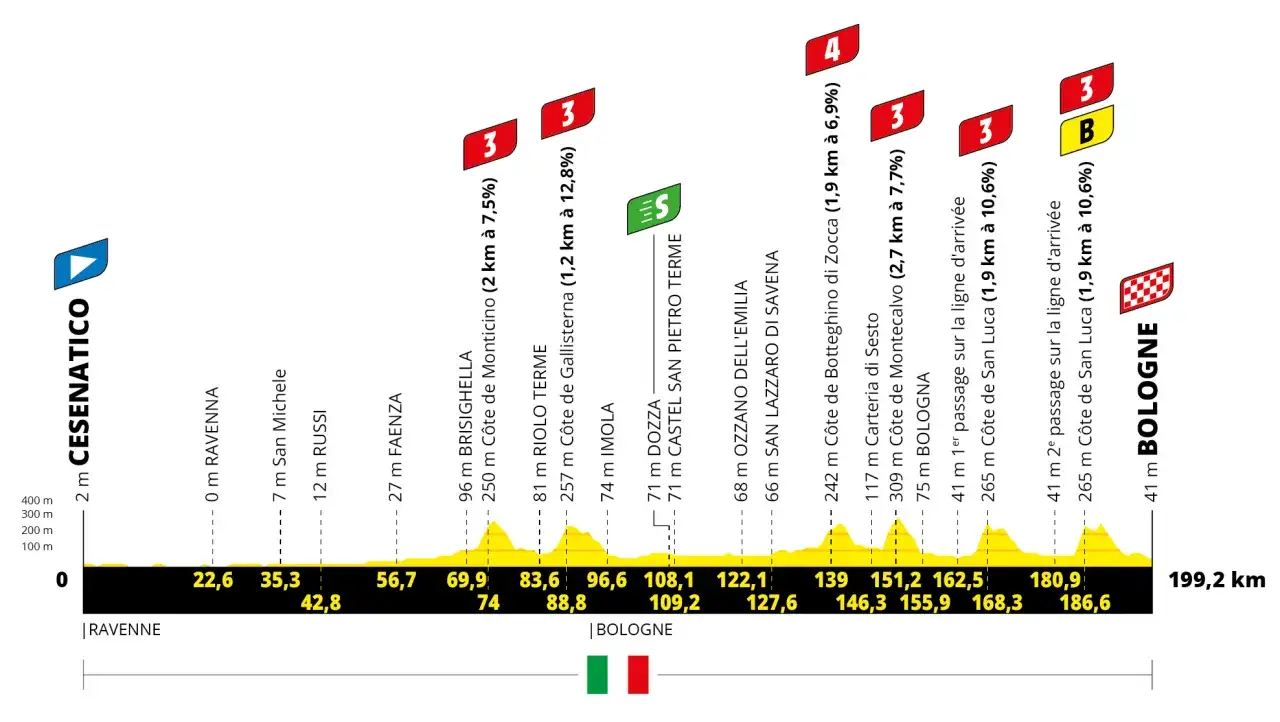
I never talk about stage length without the profile because the profile changes the meaning of the number. Flat days are often long because the race can afford the distance; mountain days are sometimes shorter, but the vertical load and repeated attacks can make them feel much bigger. That is exactly what shows up in the current route.
What the 2026 route shows in practice
On the official 2026 route, the race covers 3,298.6 km across 21 stages and includes 7 flat stages, 4 hilly stages, 8 mountain stages, 1 team time trial, 1 individual time trial, and 2 rest days. That mix is exactly why a single answer never does the race justice.
- The average stage is about 157 km, or 98 miles.
- If you remove the two time trials, the road stages average about 171 km, or 106 miles.
- One of the shortest days is the 19.6 km team time trial in Barcelona.
- The individual time trial is 26.1 km, still short by Tour standards.
- One of the longest road stages is 205.8 km from Dole to Belfort.
What I find most useful is that the route still includes several mountain stages that are close to 185 to 196 km. That is a reminder that climbing does not automatically mean short. You can have a long day, a hard finish, and serious elevation gain all at once, which is why the distance alone never tells the full story. But the route map still leaves out the biggest trap: a shorter day can be harder than a longer one.
Why a shorter day can still be harder
Distance only explains how far the riders travel. It does not explain how much energy they burn, how many times they have to surge, or how much damage the course does to the legs. That is why a 130 km mountain stage can leave riders more shattered than a 200 km flat one.
- Elevation gain A stage with 3,500 to 4,100 meters of climbing drains the legs far faster than a flat day of the same length. D+ means total vertical gain, not the size of one single climb.
- Stops and starts Hilly and mountain stages force repeated accelerations out of corners, over rollers, and on steep ramps, which is much harder than steady tempo riding.
- Wind and heat Crosswinds on the plains or a hot July afternoon can turn a moderate stage into a survival exercise, especially when the pace is already high.
- Race situation A breakaway, a sprint lead-out, or a GC attack changes the effort profile completely, even if the route distance stays the same.
When I compare two stages, I look at where the climbing sits, how exposed the roads are, and whether the finish invites an all-out attack. That is a much better way to judge the real workload, and it leads naturally into how I would use Tour distances in training.
How I would use Tour distances in training
If I were planning a long ride or a block of road-cycling training around Tour distances, I would not chase the exact kilometer count. I would match the time, the climbing, and the fueling demands instead. A 100-mile flat endurance ride and a 70-mile mountain ride are not the same workout, and the Tour is a perfect reminder of that.
- Plan by time first. A 4 to 6 hour endurance ride is a better benchmark than a flat mileage target.
- Match the profile. If the stage has repeated climbs, include sustained hill work or longer tempo intervals.
- Practice race-day fueling. Drink and eat on schedule so the distance is not the part that cracks you.
- Respect recovery. Long or high-climbing days should be followed by an easier session, not another hard push.
- For traveling cyclists, use stage towns and route maps to build a realistic riding day, not just a pretty one.
Once you start thinking this way, the numbers become useful instead of just impressive. That sets up the most practical takeaway from the whole topic.
The number matters because it tells you how the race is built
The daily distance is useful because it tells me the tactical shape of the stage. Long flat days usually point to sprint pressure and controlled breakaways. Shorter, steeper days point to attritional racing, where the field slowly fractures. Distance does not predict the winner, but it often hints at which kind of rider the stage was built for.
If you are watching from the U.S. or planning your own training rides, the cleanest takeaway is simple: treat stage length as the starting point, then check elevation, route type, and finish. That habit gives you a much truer picture of how hard a Tour day really is, and it is the same habit I use when I look at any long road stage.