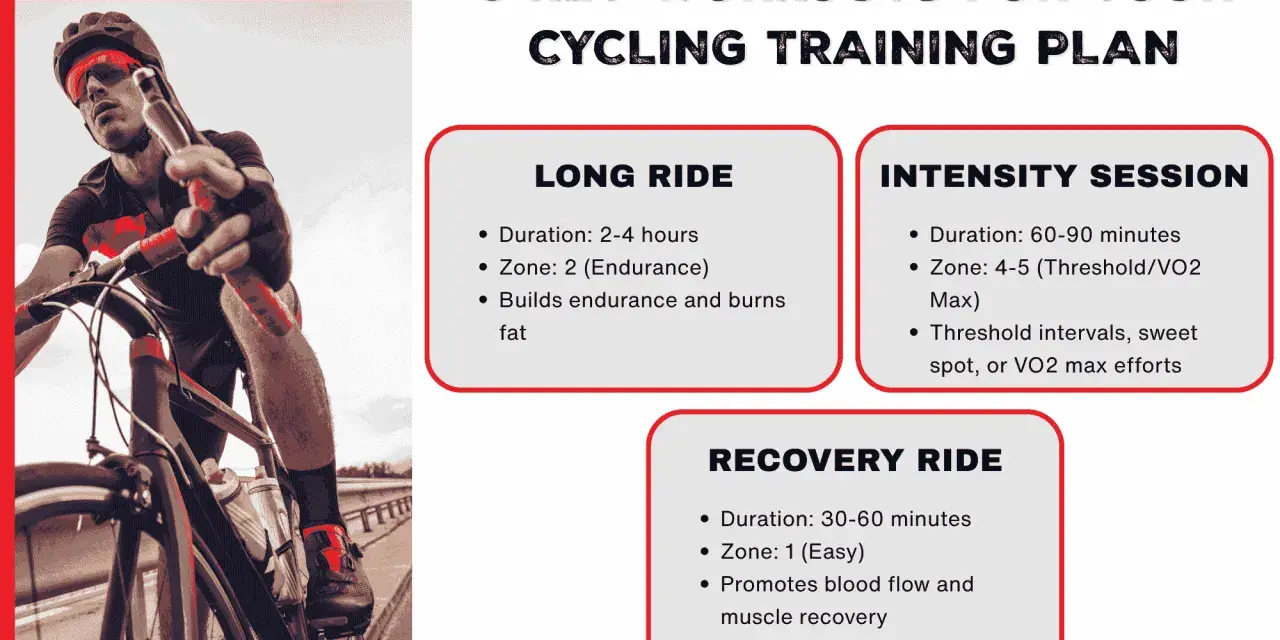
The simplest plan is the one you can repeat
- Start with your goal first: finish stronger, race better, or build all-day endurance.
- Use one long ride and one quality ride as the backbone of most weeks.
- Recovery is training, not an optional extra, especially after hard intervals.
- Power, heart rate, or feel all work if you use them consistently.
- Strength, sleep, and fueling determine whether the plan survives busy weeks.
Start with the goal before you set the mileage
I always start by asking what the rider wants in the next 8 to 12 weeks. A fitter club ride, a century, a gran fondo, or a race all demand different amounts of endurance, intensity, and recovery. If the goal is vague, the plan usually becomes a collection of random rides instead of a schedule that builds anything useful.
USA Cycling’s guidance for new racers is the right lens here: build a structured plan around cycling workouts, strength training, and rest days. I would add one more filter - how many hours can you honestly protect each week? A rider with 3 to 4 hours available needs a different structure than someone who can ride 7 to 10 hours without turning life upside down.
| Goal | Weekly riding time | Main emphasis | What it looks like |
|---|---|---|---|
| Beginner or returning rider | 2 to 4 hours | Consistency and easy endurance | Three short rides, no hero days |
| Time-crunched rider | 3 to 5 hours | Sweet spot and one long ride | Two weekday workouts, one weekend ride |
| Century or fondo goal | 4 to 8 hours | Endurance, tempo, fueling | Long weekend ride, one quality midweek session |
| Race prep | 6 to 10 hours | Threshold, VO2, handling skills | Two hard rides, one long ride, drills |
If your calendar cannot support the load, shrink the goal rather than forcing the plan to fit. Once the goal is clear, the weekly rhythm becomes much easier to design.
The weekly structure I would use first
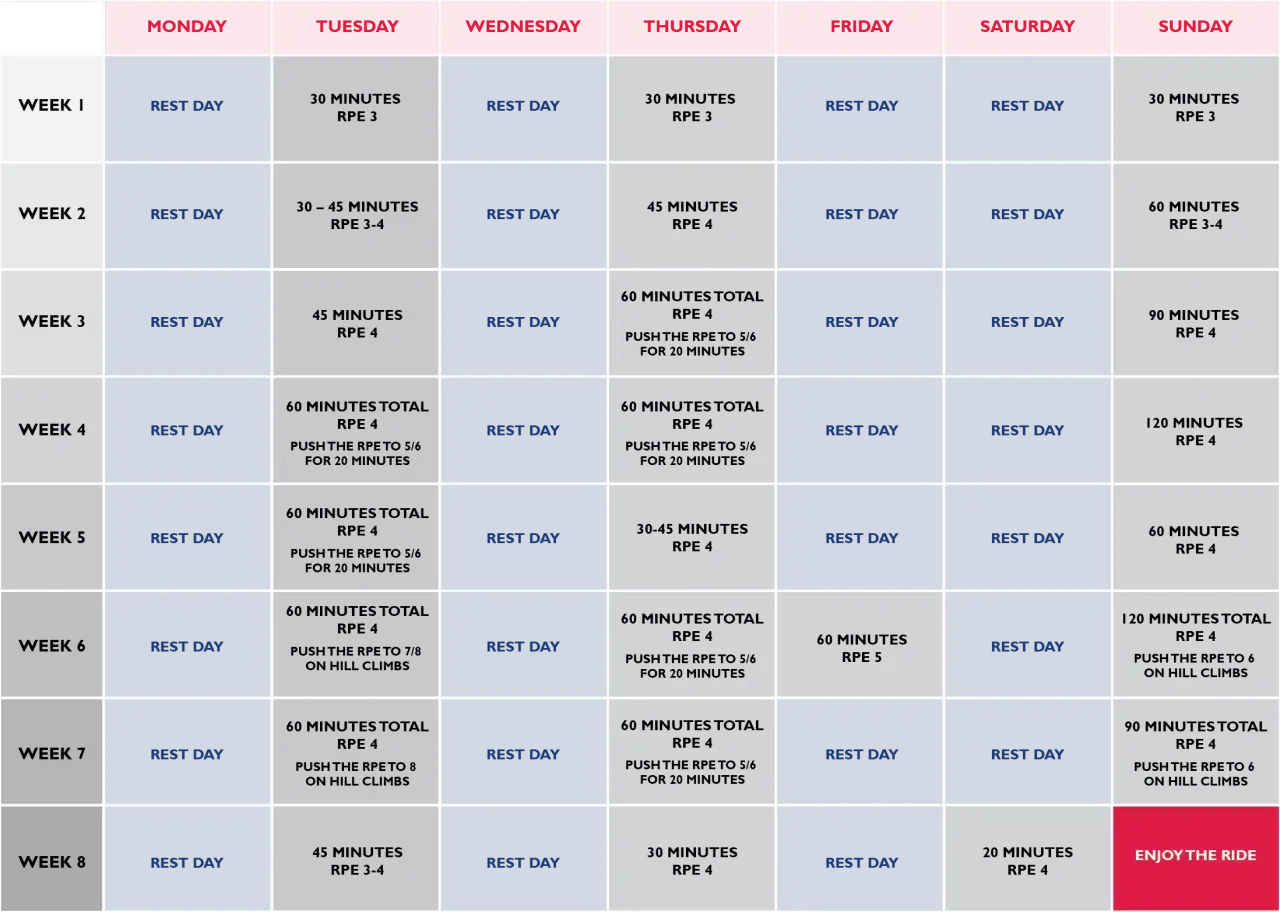
For many riders, the simplest pattern is still the most effective: two midweek rides and one longer ride at the weekend. British Cycling’s intermediate plan uses exactly that kind of rhythm, and I like it because it leaves recovery visible on the calendar instead of hiding it. That is a good thing; if every day feels important, nothing truly is.
| Day | Session | Purpose | Typical time |
|---|---|---|---|
| Monday | Rest or mobility | Recover from the weekend | 20 to 30 minutes if you move at all |
| Tuesday | Key workout | Sweet spot, threshold, or VO2 work | 60 to 90 minutes |
| Wednesday | Easy spin or off | Keep legs loose without adding fatigue | 30 to 60 minutes |
| Thursday | Endurance ride | Build aerobic base | 60 to 90 minutes |
| Friday | Strength or rest | Support the bike work | 20 to 40 minutes |
| Saturday | Long ride | Durability, fueling practice, pace control | 2 to 4 hours |
| Sunday | Recovery ride or skills ride | Absorb the load and refine handling | 45 to 90 minutes |
If you can only ride three days, keep the key workout, the endurance ride, and the long ride. Bonus sessions are useful only if they do not steal quality from those three anchors. The next question is what each of those rides should actually do.
The sessions that move the needle
I usually build a road program around five efforts: endurance, tempo, sweet spot, threshold, and VO2 max. If you train with power, the zones below are a useful map; if you do not, the feel descriptions get you close enough to train well. FTP, or functional threshold power, is the highest power you can hold for roughly an hour, and it gives those zones a practical reference point.
| Session | Typical effort | Best use | Typical duration |
|---|---|---|---|
| Recovery | Below 55% FTP, very easy | Absorb work and keep legs turning | 30 to 60 minutes |
| Endurance | 55% to 75% FTP, conversational | Aerobic base and fatigue resistance | 60 to 180 minutes |
| Tempo | 76% to 87% FTP, controlled but purposeful | Time-crunched fitness and steady pressure | 20 to 60 minutes of work |
| Sweet spot | 88% to 94% FTP, hard but sustainable | One of the best returns for limited time | 2 x 12 to 3 x 20 minutes |
| Threshold | 95% to 105% FTP, very hard but repeatable | Higher sustained speed and climbing power | 3 x 8 to 4 x 10 minutes |
| VO2 max | 106% to 120% FTP, very hard | Race sharpness and punch | 3 to 6 minute repeats |
If you train by feel instead of power, endurance should feel easy enough for conversation, tempo should feel steady and purposeful, sweet spot should feel hard but controlled, and threshold should leave you working for each sentence. I like sweet spot and threshold most for riders who want clear gains without spending endless hours on the bike. Endurance still matters most in terms of total time, because it is the layer that everything else sits on.
The practical rule is simple: one hard workout a week is enough for many riders, two for riders with more time and better recovery. If a hard ride leaves you too flat to complete the next key session, it was probably too long, too intense, or placed too close to another load. A good mix matters only if you can repeat it week after week, which is where progression comes in.
Progress by weeks, not by hero rides
The fastest way to stall is to chase a big day and then fade for the next four. I prefer to increase just one variable at a time: either add a little time, add a little intensity, or add a little frequency, but not all three in the same week. If you are measuring by hours, a 5% to 10% increase is usually enough to keep the plan moving without turning it into a gamble.
A common rhythm is two or three build weeks followed by one easier week with roughly 25% to 40% less volume. Some riders handle a three-up, one-down pattern well, while others do better with a gentler two-up, one-down cycle, especially when work stress, family life, or age makes recovery slower. The exact pattern matters less than the fact that you actually take the down week.
When I want to know whether a recovery week is overdue, I look for the same signs every time: heavy legs on easy rides, a noticeable drop in motivation, rising resting heart rate, worse sleep, or interval targets that suddenly feel absurdly hard. If two hard sessions in a row feel off, I do not call that a bad week - I call it information. The more honest you are about recovery, the more often the good sessions will actually happen.
What to do off the bike so the plan sticks
Strength work that supports cycling
Strength work is useful when it makes you sturdier on the bike, not when it turns the gym into a second sport. Two 20 to 40 minute sessions a week in the base phase is enough for most riders, and one maintenance session is usually enough once the riding load gets higher. I keep the exercises basic: squats or split squats, a hip hinge movement, calf work, and core stability. That is boring, but boring is often effective.If you are new to lifting, use moderate loads and leave a little margin in reserve. The goal is to support pedal force, posture, and injury resistance, not to leave the gym unable to climb stairs.
Fueling and hydration that prevent empty legs
For rides longer than 90 minutes, I plan food before I feel hungry. A practical starting point is 30 to 60 grams of carbohydrate per hour, with longer and harder rides sometimes needing more if your gut is trained for it. On a long weekend ride, that can be as simple as a bottle with carbs, a couple of gels, and a real-food option like a banana or rice cake.
Hydration should match the weather and the ride length. In hot U.S. summers, especially in humid regions, I would rather start drinking early and keep it steady than try to catch up later. If you wait until you are thirsty and empty, you are already making the session harder than it needed to be.
Read Also: Running vs. Cycling - Which Workout Is Best For You?
Sleep and recovery that keep the week intact
A training plan is only as good as the recovery around it. Seven to nine hours of sleep is a realistic target for many adults, and the day after a hard interval session should usually be easier, not harder. I also like to separate heavy leg work in the gym from the hardest ride when possible, because stacking fatigue too tightly usually turns both sessions into compromises.
Recovery is not a passive afterthought. It is the part of the process where the body actually adapts to the work.
Indoor trainer and open road each have a job
Indoor rides are excellent for structure and precision. On a trainer, I can hold exact wattage, cadence, and recovery times without stoplights or traffic breaking the workout. That makes indoor work ideal for VO2 intervals, threshold blocks, and cadence drills, especially when the weather is poor or the weekday schedule is tight.
Outdoor riding still matters because road cycling is not just about fitness. Cornering, descending, pacing into wind, and riding in a group all need real-road practice. In mixed weather or heavy work weeks, I would happily do the important session indoors and save the long outdoor ride for the weekend. The point is not to choose one forever; it is to use each one for what it does best.
If race day or a fast group ride is part of the goal, some of your training has to happen on the road. Trainer fitness does not automatically teach you how to hold a wheel, ride a paceline, or stay calm when the pace changes.
The mistakes that quietly ruin good training
- Turning every ride into a moderate-hard ride that never fully helps and never fully recovers.
- Adding volume before the basic schedule is consistent.
- Making the long ride hard enough to sabotage the next key workout.
- Skipping the recovery week because you still feel okay midweek.
- Underfueling long rides and then blaming fitness when power drops late.
- Copying someone else’s plan instead of matching your available time and terrain.
- Ignoring handling and group skills if road racing or fast group rides matter to your goal.
The fastest route to stagnation is to confuse being tired with being productive. A good plan should make progress visible, not simply make you more exhausted.
A template you can reuse through the season
If I had to keep one simple framework on hand all year, it would look like this:
- Three rides per week: one quality session, one endurance ride, one long ride.
- Four rides per week: add an easy spin or skills ride, not another hard workout.
- Every third or fourth week: reduce volume by about a quarter and keep intensity short.
- 7 to 10 days before an event: cut back the load, but keep a little sharpness.
That structure is not flashy, and that is exactly why it works. If I had to reduce road cycling fitness to one principle, it would be this: protect the sessions that matter, then recover well enough to repeat them next week. That is how a simple schedule turns into real progress.