Cycling is one of those workouts that feels simple until you look at what is actually happening at the joints. The practical answer to what muscles does bike riding work is that the legs do most of the power work, while the core, back, shoulders, and arms keep the movement stable and efficient. I usually split cycling into three jobs: producing force, guiding the pedal stroke, and holding a solid riding position.
The short answer is that cycling mainly trains your legs and trunk
- Quadriceps and glutes do most of the heavy lifting during the downstroke.
- Hamstrings and calves help control the pedal path and steady the lower leg.
- Core muscles keep your pelvis and torso from leaking power.
- Shoulders, arms, and back matter more on rough roads, climbs, and long rides than on a smooth trainer.
- Bike fit, cadence, and terrain can change which muscles feel the ride the most.
The muscles cycling uses most
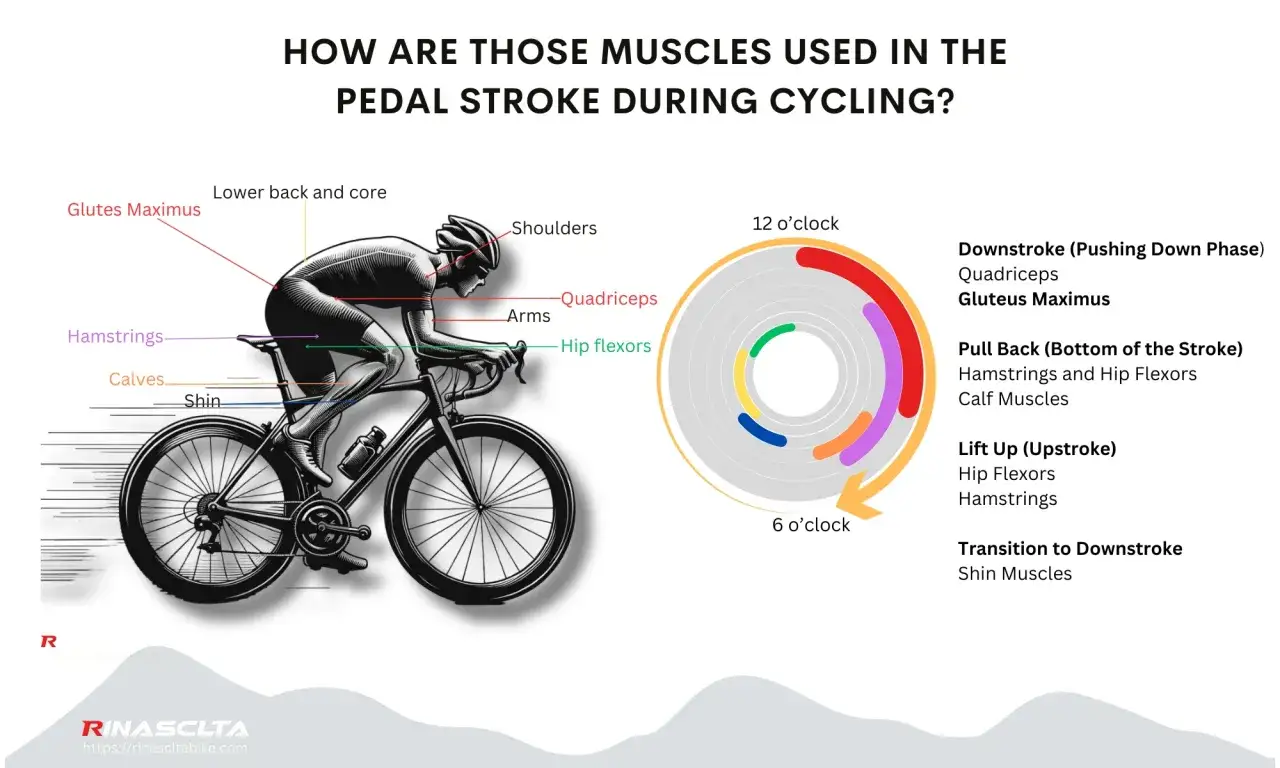
When I break cycling down by muscle group, I always start with the obvious answer first: the legs do the main power production. The quadriceps extend the knee, the glutes drive the hip, and the hamstrings and calves help shape and support the stroke rather than just sitting in the background.
| Muscle group | Main job on the bike | When you notice it most |
|---|---|---|
| Quadriceps | Extend the knee and push the pedal down | Climbs, sprints, and low-cadence riding |
| Glutes | Extend the hip and add power and stability | Standing climbs, seated power efforts, hard accelerations |
| Hamstrings | Assist hip extension and help stabilize the knee | The back half of the stroke and longer efforts |
| Calves | Stabilize the ankle and smooth force transfer | High cadence, standing efforts, rough terrain |
| Hip flexors | Lift the thigh during recovery and help reposition the leg | Smoother spin, faster cadence, pedaling fatigue |
| Core and lower back | Keep the pelvis and trunk steady | Long rides, climbing, sprinting, and any position change |
| Shoulders, arms, and upper back | Support the torso and help steering and control | Gravel, mountain biking, descents, and long hours in the saddle |
The part people miss most often is the core and upper body. They are not the engines, but they decide how much of your leg power actually reaches the pedals. If your trunk collapses or your hips wobble, the ride feels harder even when your legs are strong. That becomes clearer once you look at how the pedal stroke distributes the work.
How the pedal stroke spreads the load
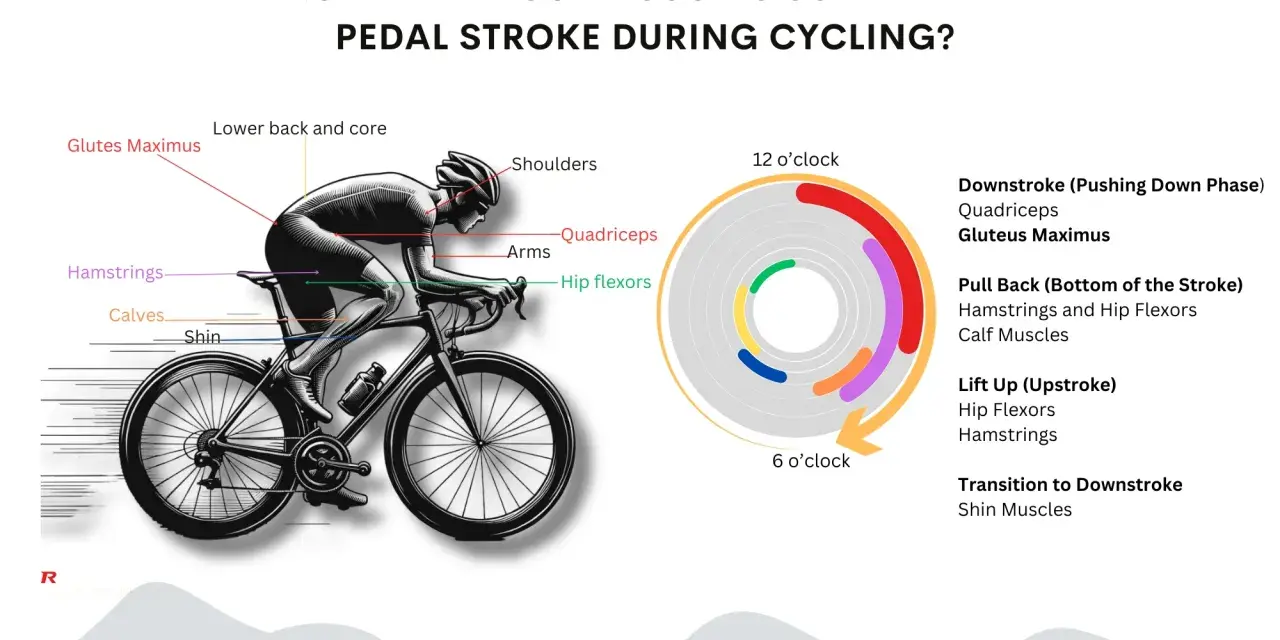
A pedal stroke is not one single movement. It is a loop, and different muscles take over at different points in that loop. That is why a rider can feel quad-dominant on one bike, glute-dominant on another, and oddly cramped in the hip flexors on a third.
Downstroke
From the top of the stroke through the strongest part of the push, the quadriceps and glutes do most of the work. This is the part that creates the feeling of power, especially when you are climbing or riding a big gear. In plain terms, the downstroke is where you generate torque, which is the twisting force that turns the crank.
Recovery phase
On the way back up, the hip flexors help lift and reposition the leg, while the hamstrings and calves keep the movement controlled. That does not mean you are “pulling up” hard on every revolution, at least not in a way that replaces the push phase. It means the upper and lower leg are coordinating so the next downstroke starts cleanly.
Read Also: Cycling Watts Explained - Master Your Power & Training
Standing efforts
When you stand to climb or sprint, the pattern changes fast. More body weight moves through the pedals, the glutes usually contribute more, and the calves, core, shoulders, and arms all work harder to keep the bike steady. That is why a steep climb can feel like a full-body effort even though the legs are still doing most of the force production.
Once you understand that rhythm, it becomes easier to see why fit and riding style change what you feel most on the bike.
Why bike fit, cadence, and terrain change which muscles work hardest
The same rider can feel like they are getting a quad workout on one bike and a glute workout on another, and that is not imaginary. Small changes in position, gear choice, and terrain shift the load noticeably. In my experience, this is where a lot of riders misread the ride and assume the bike is “working the wrong muscles,” when the real issue is usually how the workload is being distributed.
- Lower saddle position often increases quad dominance and can make the front of the thigh burn sooner.
- Too much saddle height can make you reach for the bottom of the stroke, which may overwork the hamstrings and irritate the hips or lower back.
- Higher cadence usually lowers the force per pedal stroke and shifts the effort toward endurance and coordination.
- Lower cadence with a bigger gear increases torque, so the quads and glutes have to produce more force each stroke.
- Rough roads, gravel, and trail riding demand more isometric work from the core, shoulders, arms, and grip. Isometric means the muscle is contracting without obvious movement.
Bike fit is the quiet variable here. A well-set saddle and cockpit let the big leg muscles do their job without forcing the hips, knees, or low back to compensate. A poor fit can still make you strong, but it often makes the wrong muscles feel overworked first. That matters if you want cycling to make you fitter rather than just more tired.
How to train the muscles cycling leaves behind
Cycling builds a lot of endurance, but it does not fully replace strength work. If you want better power on the bike, I like to think in terms of support work: build the muscles that drive the pedals, then build the ones that keep the system stable and durable.
A practical off-bike template is simple and effective:
- 2 strength sessions per week during most of the year.
- 2 to 4 sets per exercise.
- 6 to 12 controlled reps for main lifts, depending on the season and your experience.
- 20 to 40 seconds for core holds when you want endurance-style trunk work.
The best exercises are usually the boring ones that actually transfer:
- Squats or split squats for quad and glute strength.
- Romanian deadlifts or other hip hinges for hamstrings and glutes.
- Step-ups and lunges for single-leg control and hip stability.
- Planks, dead bugs, and Pallof presses for anti-extension and anti-rotation core work. Anti-rotation means resisting twisting, which is exactly what a bike asks the trunk to do.
- Rows, push-ups, and carries for upper-body endurance and posture.
I would keep the volume modest during peak riding blocks. The goal is not to trash your legs in the gym and then limp through interval day. The goal is to make the bike feel more stable, more efficient, and less dependent on one overworked muscle group. That becomes even more useful when you compare different kinds of rides.
How road rides, indoor sessions, and trail riding differ
Not all cycling places the same demand on the body. The machine, the surface, and the riding position all change how the work is spread around. If you only ever ride one type of bike, it is easy to assume that is what cycling “normally” feels like.
| Ride type | What works hardest | Why it feels different |
|---|---|---|
| Indoor trainer or spin bike | Quads, glutes, core | Stable setup, steady resistance, very little steering demand |
| Road cycling | Quads, glutes, hamstrings, calves | More cadence changes, more posture shifts, more wind and terrain variation |
| Climbing | Glutes, quads, calves, core | Higher torque and more bodyweight support on the pedals |
| Gravel or mountain biking | Core, shoulders, arms, grip, glutes | Frequent balancing, braking, steering corrections, and body bracing |
An indoor ride usually isolates the legs more cleanly, which is great for repeatable training. Off-road riding asks for more stabilizing work because the bike is constantly reacting to the ground underneath it. Road riding sits somewhere in the middle, and that is why it often gives the most balanced muscle stimulus for a lot of cyclists.
What cycling does not fully replace
Bike riding is excellent for leg endurance, but it does not train everything equally. That is not a flaw, just a reminder that cycling is a specific pattern, not a full-body substitute for every kind of strength or movement quality.
- It does not fully build upper-body strength. Your arms, shoulders, and back assist, but they are not loaded like they would be in pulling, pressing, or carrying work.
- It does not provide much impact loading. If bone density or impact tolerance matters, some riders also need walking, running, jumping, or resistance training if appropriate.
- It can undertrain lateral stability. Cycling is mostly forward motion, so side-to-side control needs help from single-leg work and core training.
- It favors repetitive endurance. That is a strength for fitness, but not the same thing as raw force production or sprint power.
That is why the most complete cyclists I work with do not rely on miles alone. They ride to build engine, then use strength work to keep the body balanced around that engine. When those two pieces line up, the bike feels easier, not harder.
The most useful way to think about cycling muscles
If I had to reduce the whole topic to one practical rule, it would be this: quads and glutes power the ride, hamstrings and calves refine it, and the core and upper body keep it efficient. That framework is more useful than obsessing over any single muscle name, because cycling is a coordinated pattern, not a one-muscle exercise.
So if your legs burn first, that is normal. If your hips, back, or shoulders feel overloaded, that is usually a clue that fit, cadence, terrain, or support strength needs attention. Get those pieces right and cycling becomes what it should be: a strong, repeatable workout that builds endurance, power, and stability at the same time.