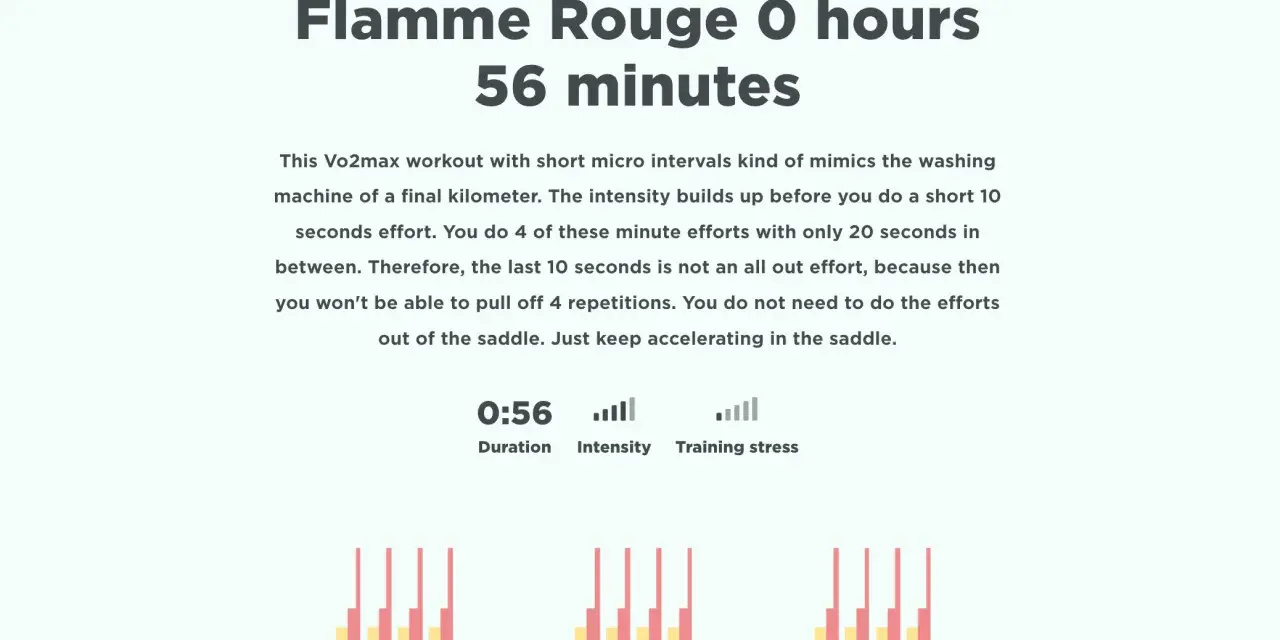
High intensity cycling works best when it is treated as a tool, not a personality trait. Done well, it improves power, climbing, and aerobic fitness without demanding endless hours on the bike. In this article I break down what the work actually trains, when it belongs in your week, how to build a session that makes sense, and which recovery and gear choices make the biggest difference.
Key points at a glance
- Interval cycling targets VO2 max, fatigue resistance, and the ability to repeat hard efforts.
- Most riders get the best return from 1 to 2 hard sessions per week, not more.
- A session needs a real warm-up, a clear work block, and enough recovery to keep the quality high.
- Fuel, sleep, and hydration decide whether the second half of the workout matches the first.
- A power meter, heart-rate monitor, fan, and good indoor setup make hard training more repeatable.
What hard interval riding actually trains
I think of hard interval work as a targeted stress test, not just a fitness flex. Short, intense efforts push the systems that steady riding barely touches: your ability to process oxygen, tolerate rising fatigue, recruit fast-twitch fibers, and keep producing power when the legs start to flood. That is why cyclists use it to raise VO2 max, improve threshold power, and make surges feel less expensive.
There is a practical side to that physiology. A rider who can repeat hard efforts with less drop-off will usually feel better on climbs, during bridge attempts, and in the final kilometer of a fast group ride. You are not only training the engine; you are also teaching the legs and nervous system to recover more quickly between attacks.
The part many riders miss is that the benefit comes from the combination of stress and restraint. One excellent session can move the needle; three sloppy ones often just leave you flat. That is why the next question is not whether the work is hard enough, but when it actually deserves a place in your week.
When to add it and when to hold back
Hard interval training makes the most sense when your goal is speed, climbing, race sharpness, or getting more fitness out of limited time. It is especially effective if you already have an endurance base and want to make that base more usable.
It is less useful as an everyday default. If you are brand new, rebuilding after a break, or carrying persistent fatigue, I would first make sure you can ride consistently, sleep well, and recover from easier volume before adding intensity. The fastest path is usually not the hardest one.
| Goal | Best use of intervals | What to watch |
|---|---|---|
| Group rides and climbs | 3 to 5 minute VO2-style repeats | Do not place them right after a long, draining ride |
| Short attacks and sprints | 10 to 30 second max efforts with full recovery | They work best when the legs are fresh and the form stays clean |
| Time-efficient fitness | 30 second to 4 minute repeats once or twice a week | Fueling and sleep matter more than usual |
| Base-season maintenance | One focused session plus easy endurance | Avoid turning every ride into threshold work |
If a week already includes a hard club ride, a long climb day, or a race, the "one more hard day" idea usually backfires. Once the timing is right, the next step is choosing a session format that matches the adaptation you want.

How to structure a session without guessing
A good session has a warm-up, a clear work set, enough recovery to hit the next effort properly, and a cooldown. When those pieces are missing, the workout feels hard but the training effect is usually worse.
If you train with power, VO2-style intervals often land around 110 to 120 percent of FTP, which is functional threshold power, or the highest power you can hold for about an hour. If you do not use power, use breathing and repeatability as the guardrails: the effort should feel very hard, but not like an all-out panic sprint unless that is the point of the session.
| Session type | Example | What it is good for |
|---|---|---|
| Short power repeats | 8 to 12 x 30 seconds hard, 90 seconds easy | Surges, accelerations, and repeated punchy efforts |
| VO2 builder | 4 to 6 x 3 minutes hard, 3 minutes easy | Climbing speed, race pace tolerance, and aerobic ceiling |
| Sprint work | 6 to 8 x 10 to 15 seconds all-out, 2 to 4 minutes easy | Neuromuscular power and top-end speed |
- Warm up for 10 to 15 minutes. Add 3 to 5 short openers so the first interval does not feel like a shock.
- Pick one main stimulus. Do not combine sprint work and threshold grinding in the same workout unless the plan is deliberate.
- Protect interval quality. If power or pace drops sharply, end the set before the session turns into survival mode.
- Cool down for about 10 minutes. Easy spinning helps the legs settle and keeps the workout from ending with a hard stop.
I prefer riders to repeat one format for a few weeks before changing it. That makes progress easier to see and keeps the workout from becoming random effort soup. From there, consistency depends on how often you can absorb the stress and come back fresh enough to do it again.
How often you should do it and what recovery looks like
For most riders, one or two hard sessions per week is the sweet spot. A third session can work in a short build block, but only if the rest of the week is genuinely easy and you are sleeping and eating enough.
I usually tell riders to respect a 24 to 48 hour buffer after a maximal session. If you repeat hard work sooner than that, the quality usually drops and the next workout becomes a compromise. The goal is not to stack suffering; it is to produce useful adaptations.
- Eat 30 to 60 grams of carbohydrate 30 to 90 minutes before longer sessions.
- For efforts over about 60 minutes, aim for 30 to 60 grams of carbohydrate per hour and enough fluid to replace what you sweat.
- After the ride, get 20 to 30 grams of protein plus carbs within a couple of hours.
- Back off if you see a rising resting heart rate, unusual irritability, poor sleep, or power numbers that keep slipping.
When riders feel stale, the issue is often the schedule around the workout, not the workout itself. Recovery becomes much easier when the tools and setup help you hit the same targets every time.
The gear and setup that make hard efforts more useful
On the bike, the best gear is the gear that removes friction. A power meter tells you whether the effort is really where you think it is. A heart-rate monitor helps you see how the body is responding, although it lags behind sudden changes. A smart trainer or a quiet road with few interruptions makes repeated efforts much easier to execute.
| Tool or setup | Why it matters | My practical take |
|---|---|---|
| Power meter | Shows actual work output | The best pacing tool if you want repeatable intervals and real progress |
| Heart-rate monitor | Shows how hard the body is responding | Useful for longer efforts and recovery, but not ideal as the only guide |
| Fan | Keeps indoor body temperature under control | Probably the cheapest upgrade that improves session quality |
| Smart trainer | Removes traffic, stops, and terrain noise | Great for intervals that need exact timing and resistance |
| Stable gearing and tire pressure | Helps cadence and traction stay consistent | Small detail, but it matters when you are trying to repeat a cadence target |
For most hard intervals, I like a cadence that feels smooth and controlled, often around 85 to 100 rpm, but the right number is the one that lets you stay powerful without mashing. If I had to choose only one purchase for indoor work, it would be a fan before almost anything else. With that in place, the only thing left is a simple weekly pattern you can repeat without guesswork.
The cleanest way to build speed without burning out
If I were rebuilding speed for a rider who wants better fitness without living on the edge of fatigue, I would start with one focused session per week, repeat the same format for three or four weeks, and keep the rest of the week mostly easy. That gives you a clean signal: if your power, breathing, and recovery all improve against the same workload, the plan is working.
- Choose one format first, such as 4 x 3 minutes hard or 8 x 30 seconds hard.
- Place it after an easy day, not after a long, draining ride.
- Leave at least one full easy day after it.
- Add a second hard day only when you are sleeping well, eating enough, and finishing workouts strong.
The riders who progress fastest are usually not the ones who suffer the most in one week; they are the ones who can repeat quality work month after month. Keep the sessions sharp, keep the recovery honest, and let the fitness build from there.