The fastest gains come from a plan that balances load, recovery, and specificity
- Consistency wins: three good months of repeatable training beat two weeks of hero workouts.
- Most riding should feel easy, with only one or two truly demanding sessions each week.
- Training should match your goal, whether that means endurance, climbing, racing, or general fitness.
- Recovery is part of the plan, not a reward you earn after you are already exhausted.
- Measurable progress matters: better power, pace, heart-rate efficiency, and repeatability all count.
What a good cycling plan has to deliver
When I build a plan, I care less about the label on it and more about whether it produces repeatable progress. A useful program has to do four things at once: raise fitness, fit real life, avoid burnout, and keep the rider moving toward a clear target. If it misses any of those, it usually looks impressive on paper and falls apart in week three.
Progressive overload
Your body adapts when training stress rises gradually. That can mean a little more volume, a slightly longer interval, or a harder second half of a ride. It should feel like a step forward, not a leap into fatigue.
Specificity
You get better at what you practice. If you want to climb, you need sustained work near threshold and enough endurance to hold form late in the ride. If you want better sprinting, short explosive efforts matter more than endless tempo miles.
Recovery
Adaptation happens after the session, not during it. That is why the plan has to protect sleep, rest days, and easier rides. A rider who never truly recovers tends to collect fatigue faster than fitness.
Measurable intensity
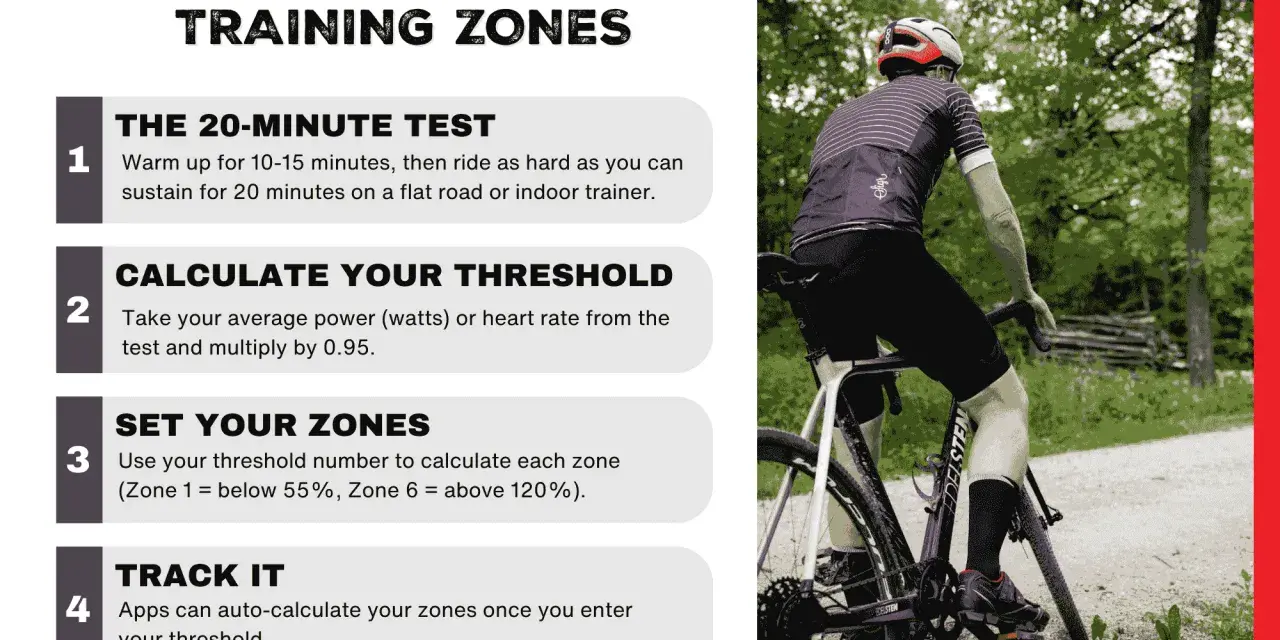
A serious plan uses power, heart rate, or perceived exertion to keep effort honest. Functional threshold power, or FTP, is useful because it gives you a reference point for interval work, but the number itself is only helpful if you train around it intelligently. Once those pieces are in place, the next question is simple: which version fits your time and ambition?
Choose the right plan for your level and goal
The right structure depends on how much time you can train and what you want the bike to do for you. A rider with four hours a week should not copy a 12-hour race build. That mismatch is one of the fastest ways to stall progress.
| Rider profile | Typical weekly time | What the plan should emphasize | Best fit |
|---|---|---|---|
| Beginner | 4-6 hours | Consistency, basic endurance, one light structured session, one longer easy ride | New riders, general fitness, confidence on the bike |
| Intermediate | 6-10 hours | Two quality sessions, one long ride, controlled recovery, a simple build/recovery rhythm | Riders who want to climb better, ride faster group rides, or improve fondo fitness |
| Advanced | 10-16+ hours | Higher volume, race-specific intervals, careful fatigue management, bigger aerobic base | Competitive cyclists and riders peaking for events |
| Time-crunched | 3-5 hours | One hard session, one endurance ride, one longer weekend ride if possible | Busy riders who need the most return per hour |
If your goal is a specific event, I like a plan that ends with a clear peak phase and a short taper. If your goal is overall fitness, a simpler 8- to 12-week block with regular recovery weeks is usually enough to produce a visible change. Once you know the category, the weekly rhythm becomes much easier to build.
How to structure a cycling week that fits real life
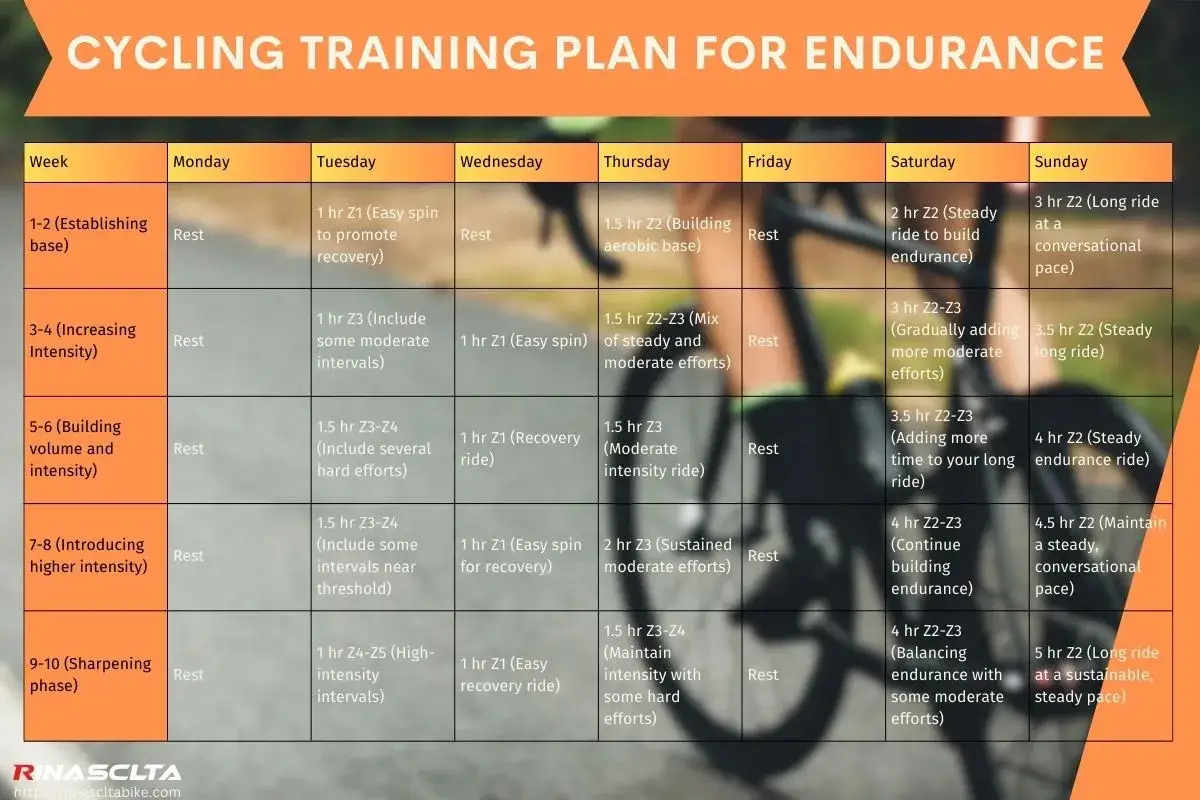
Most riders do better with a predictable rhythm than with random training days. I usually think in terms of one hard day, one endurance day, one long ride, and enough recovery to make the next quality session useful. That can be scaled up or down, but the shape stays the same.
| Day | Session | Purpose |
|---|---|---|
| Monday | Rest or very easy spin | Absorb the previous week and start fresh |
| Tuesday | Structured intervals | Build threshold, VO2 max, or race-specific power |
| Wednesday | Endurance ride | Grow aerobic capacity without adding much fatigue |
| Thursday | Second quality session or strength work | Reinforce adaptation without stacking too many hard days |
| Friday | Rest or recovery ride | Keep legs moving while preserving freshness |
| Saturday | Long ride | Improve endurance, fueling, and fatigue resistance |
| Sunday | Easy ride or off-bike recovery | Reset before the next build begins |
If you only have four riding days, keep the same logic and remove the least important session, not the long ride or the key interval day. For most busy riders, that means two quality days at most, one endurance ride, and one longer ride. The weekly skeleton only works if the right sessions are inside it.
The workouts that move the needle
A strong plan is not built from every workout under the sun. It is built from a few session types that each solve a different problem. Here is the mix I keep coming back to.
Endurance rides
Endurance work is the foundation. These rides are usually conversational pace, often in zone 2 if you train with power, and they can run from 60 minutes to several hours depending on the rider. They matter because they improve aerobic efficiency, help you tolerate volume, and make harder workouts feel less expensive.
Sweet spot and threshold work
Sweet spot sits just below threshold and is hard but sustainable; threshold is the highest steady effort you can hold for a meaningful amount of time. Sessions like 2 x 20 minutes, 3 x 12 minutes, or 4 x 10 minutes are common because they build sustained power without requiring you to go all-out. For riders chasing climbs, time trials, or stronger group rides, this is often where the biggest gains come from.
VO2 max intervals
VO2 max work is short, intense, and uncomfortable in the right way. Think 4 x 4 minutes or 5 x 3 minutes with enough recovery to keep the quality high. These sessions improve your ability to tolerate hard efforts above threshold, which helps in attacks, punchy climbs, and surges in racing.
Sprints and neuromuscular work
Short all-out efforts of 6 to 10 seconds improve top-end power and bike handling under pressure. They do not take much total time, but they need full recovery between reps so the work stays explosive. I like them especially for riders who want better acceleration in group rides or criterium-style efforts.
Read Also: FTP Fitness Meaning - Maximize Your Cycling Power
Strength training
Off-bike strength work is still worth doing, especially in the base phase. Two sessions a week can help with durability, posture, and force production, but the goal is support, not exhaustion. Once racing or peak riding gets closer, one session a week is often enough to maintain what you built.
The exact mix depends on the goal, but the pattern is consistent: mostly easy riding, a limited amount of very hard work, and enough volume to make the engine bigger. Even a well-designed week will fail, though, if the rider keeps making the same avoidable mistakes.
Common mistakes that slow progress
I see the same errors over and over, and they are usually more damaging than a slightly imperfect workout plan. Most are simple to fix once you notice them.
- Turning every ride into moderate-hard effort. That gray-zone habit creates fatigue without giving you a clean easy day or a truly hard day.
- Copying a pro-level program. A rider with a job, family, and seven hours a week needs a very different structure from someone training full-time.
- Adding intensity before the aerobic base is ready. Without enough steady riding, hard workouts often just become expensive fatigue.
- Testing too often. FTP checks are useful, but they do not replace consistent training. I prefer testing only when the plan needs a reset or a new training zone.
- Ignoring fueling. Under-fueled sessions usually start strong and finish flat. For longer or harder rides, consistent carbohydrate intake makes a real difference.
- Skipping recovery weeks. Fitness rises when stress and recovery are balanced. When the recovery week disappears, performance usually follows.
If any of those sound familiar, the solution is usually not a brand-new plan. It is fewer hard days, better pacing, and a cleaner weekly rhythm. Once the mistakes are under control, you can judge the plan by whether it is actually making you better.
How to know whether the plan is working
Progress is not just about one big test number. I look for several signs that tell me the body is adapting without breaking down.
- You can hold the same power with less strain. That usually means improved efficiency and better aerobic fitness.
- Hard sessions become repeatable. If the first interval and the last interval look similar, the plan is doing its job.
- Recovery between sessions improves. You should feel more normal by the next day, not more crushed each week.
- Long rides feel steadier. Good endurance shows up as fewer late-ride fades and less form collapse.
- Your motivation stays intact. A plan that destroys consistency is too aggressive, even if the workouts look impressive.
If the opposite is happening for more than a week or two, I would reduce load rather than push through blindly. A slight drop in volume or intensity is often enough to restore adaptation. With that in mind, here is the template I would start most riders on.
The simple plan I would start most riders on
For a lot of riders, the smartest starting point is not a complicated block. It is an 8- to 12-week cycle built around one long ride, one threshold or sweet spot session, one endurance ride, one optional second quality day, and a recovery week every three or four weeks. That structure gives you enough stress to improve without making every week feel like survival.
- Beginner: 3 rides per week, 4-6 total hours, one light interval session, one longer easy ride, one or two recovery days.
- Intermediate: 4-5 rides per week, 6-10 total hours, two quality sessions, one long ride, one strength session.
- Advanced: 5-6 rides per week, 10+ total hours, two focused hard sessions, more aerobic volume, and tighter fatigue control.
If I had to give one rule that matters most, it would be this: pick the plan you can execute for months, not the one that sounds toughest for a single week. That is how riders build real fitness, not just temporary exhaustion. Once the structure is right, the gains usually show up faster than people expect.