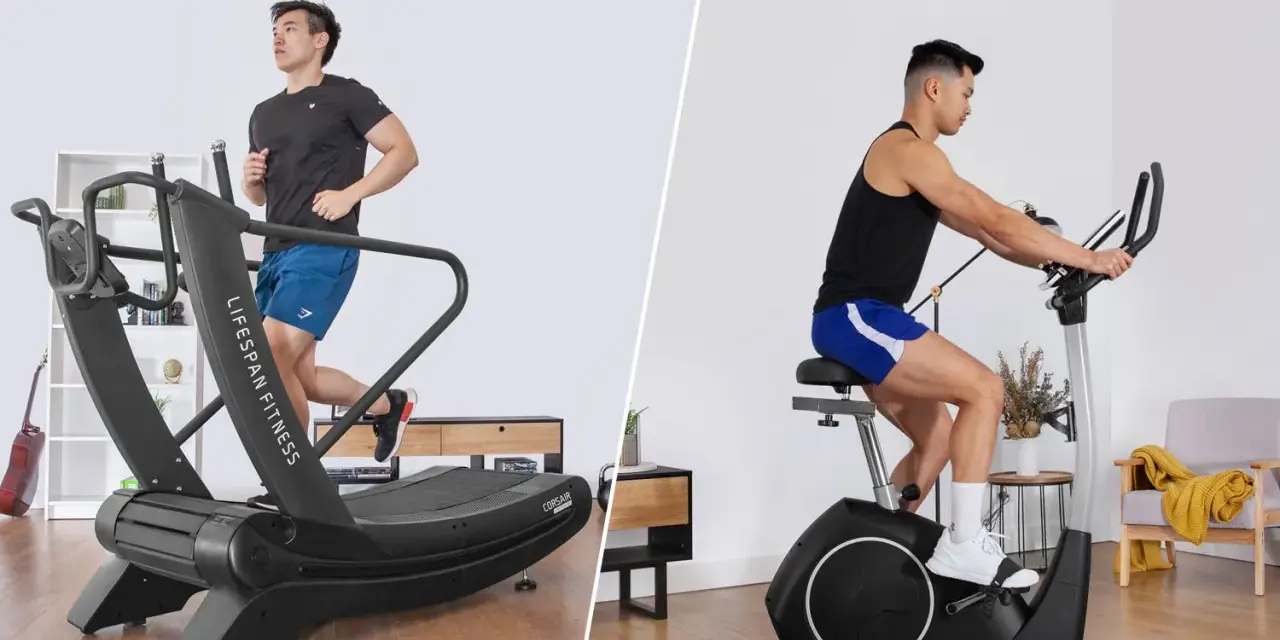
The best choice depends on your joints, your goals, and how hard you want to train
- Pick the bike if you want a joint-friendlier cardio option that still lets you push hard.
- Pick the treadmill if you want weight-bearing work, walking or running practice, and a stronger impact stimulus.
- For calorie burn, the treadmill usually wins at higher speeds, but a hard bike workout can close the gap quickly.
- For cyclists, the bike is the more specific training tool because cadence and resistance translate directly.
- The best machine is the one you can repeat consistently, not the one that looks best on paper.
How the two machines change the work your body does
I start with mechanics because that is where the real difference lives. A bike keeps you seated and supported, so the legs do most of the work while the joints absorb less shock. A treadmill asks you to carry your body weight, control each stride, and deal with repeated ground contact, which makes the whole effort feel more demanding even when the pace looks modest.
That changes the training effect in a few important ways:
- Bike: smoother motion, less impact, easier to keep going for longer, and easier to control resistance precisely.
- Treadmill: more natural walking and running mechanics, more load through the feet, ankles, knees, and hips, and more carryover if your goal is running fitness.
- Indoor cycling: lets you focus on cadence, resistance, and interval structure without worrying about balance or traffic.
- Walking or running on a treadmill: gives you a direct practice lane for outdoor locomotion, which matters if you want better stride economy or brisk-walking fitness.
If I had to reduce it to one sentence, I’d say the bike is easier on the body while the treadmill is more demanding on the system. That difference becomes obvious once you compare calories and intensity side by side.
Calories and intensity are not the same thing

Harvard Health’s calorie table is a useful reality check here. A 30-minute moderate stationary-bike session comes in at about 210 calories for a 125-pound person, 252 for a 155-pound person, and 294 for a 185-pound person. For comparison, walking on a treadmill at 3.5 mph is lower, while running at 5 mph climbs above the bike.
| 30-minute example | 125 lb | 155 lb | 185 lb | What it means |
|---|---|---|---|---|
| Stationary bike, moderate | 210 | 252 | 294 | Solid cardio, especially if the resistance is real and not just light spinning |
| Treadmill walking at 3.5 mph | 107 | 133 | 159 | Useful, but usually easier than moderate cycling |
| Treadmill running at 5 mph | 240 | 288 | 336 | Typically the stronger burn, but at a higher impact cost |
The part people miss is that intensity, duration, and tolerance all matter at the same time. A treadmill can burn more per minute if you run hard, but if your knees or shins shut that down after 12 minutes, the bike may produce a better weekly result because you can stay on it longer and recover faster. My rule is simple: the machine that lets you accumulate more honest work usually wins in the real world.
That brings us to the next question most readers care about: which machine is actually easier to live with when your body is not feeling perfect?
Joint stress, recovery, and when comfort should decide
If your knees, hips, ankles, or lower back get irritated easily, the bike is usually the more forgiving choice. The motion is smoother, there is less impact, and it is easier to control effort without asking your body to absorb repeated landing forces. That is one reason people returning from a break often tolerate cycling before they tolerate running.
The treadmill is not automatically a bad option, but it is less forgiving when form breaks down. Holding the rails, overstriding, or pushing incline too aggressively can turn a simple walk into a sloppy one. I also think beginners sometimes underestimate how much stress comes from repeated foot strike, especially if they jump straight into running instead of building up with walking intervals.
- If pain changes your stride, stop and scale back.
- If you need to grip the treadmill rails, the pace or incline is probably too high.
- If your bike seat is too low, your knees will complain sooner than your lungs do.
- If your body needs a lower-stress day, the bike usually gives you more room to keep moving.
When the goal is to protect joints without stopping cardio altogether, the bike has the edge. Once comfort is sorted out, the smarter question becomes which machine matches the outcome you want most.
Which machine fits your actual goal
This is where I stop thinking in absolutes. There is no universal winner, because the better machine changes with the goal.
| Your goal | Better pick | Why it usually wins |
|---|---|---|
| Protect knees or hips | Bike | Less impact and easier resistance control |
| Train for running or brisk walking | Treadmill | Specific gait practice and weight-bearing work |
| Train like a cyclist | Bike | Cadence, resistance, and interval work carry over directly |
| Burn more calories in a shorter run-style workout | Treadmill | Running generally drives higher minute-for-minute output |
| Make cardio fit into a small home setup | Bike | Usually quieter and easier to place in a room |
| Build a habit you can repeat often | Either one | The machine you enjoy is the one you will actually use |
Once you know the goal, the last step is making the machine itself work harder for you instead of just taking up floor space.
How I make either machine more effective
The American Heart Association recommends at least 150 minutes of moderate aerobic activity or 75 minutes of vigorous activity each week, plus strength work on at least two days. I like that benchmark because it keeps the focus on weekly consistency, not on a single heroic session.
On the bike
- Use enough resistance that the pedals feel smooth, not empty.
- Try interval blocks such as 6 rounds of 2 minutes hard and 2 minutes easy.
- Check saddle height first; a bad fit wastes effort and can irritate the knees.
- Do not confuse fast leg speed with real work if the resistance is too light.
On the treadmill
- Use walking intervals or incline changes instead of hanging onto a single easy pace forever.
- Keep your posture tall and your stride controlled instead of reaching forward with each step.
- Build speed gradually, especially if you are coming from a low-activity routine.
- For runners, structure matters more than chasing a random calorie number on the console.
Read Also: MTB Tire Pressure - The Ultimate Trail Setup Guide
For both
- Warm up for 5 to 10 minutes before the hard work starts.
- Use RPE, or rate of perceived exertion, to judge how hard the workout feels.
- Pair cardio with strength training so the lower body can tolerate more work over time.
- Track sessions you can repeat next week, not workouts that leave you wrecked for two days.
Once the sessions are set up correctly, the remaining question is not which machine is tougher. It is which one fits the way you want to train over the next several months.
What I would choose in the real world
If I had to choose one machine for most people, I would start with the one that removes the biggest friction. For sore knees, a bike usually wins. For someone who wants to improve walking or running, or who wants more weight-bearing work, the treadmill makes more sense. For a cyclist, the bike is the more relevant option almost every time because it lets you train cadence, resistance, and endurance in the same pattern you use on the road.
The best setup is often not an either-or decision. I like a bike for low-stress volume and recovery days, then a treadmill for impact, walking fitness, or intervals that I want to keep honest. If you can make either machine part of a weekly routine you actually enjoy, you have already made the smarter choice.