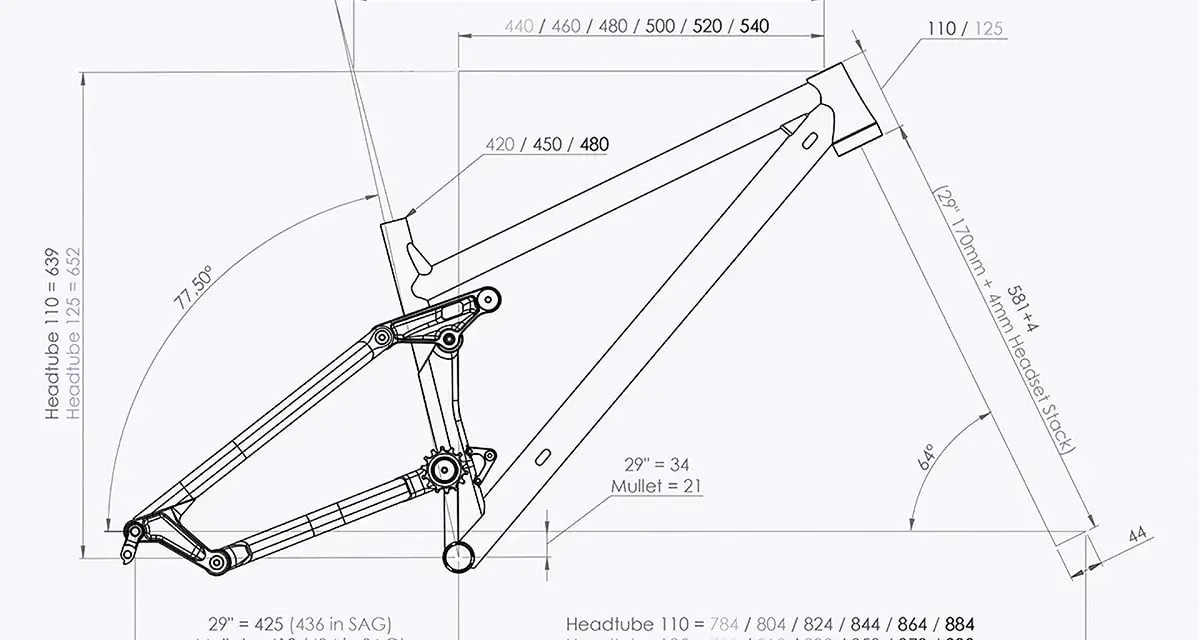
The mtb head tube angle is one of the clearest clues to how a mountain bike will steer, feel at speed, and behave when the trail gets steep or messy. A few degrees can make the front end calmer on descents, quicker in tight corners, or easier to place on slow technical climbs. In this guide, I’ll break down what the number actually means, what ranges make sense for different riding styles, and how I judge it alongside reach, fork offset, and wheel size.
The angle is a steering choice, not a standalone verdict
- Slack angles add stability and confidence when the speed rises or the trail points down.
- Steep angles make steering quicker and climbing feel more direct, especially on slower terrain.
- Most modern XC, trail, enduro, and downhill bikes sit in different angle bands for a reason.
- Fork offset, reach, travel, and sag can change the real-world feel as much as the printed number.
- I would never buy a bike on head angle alone, because the front-end package matters more than the headline spec.
What the head angle actually changes on the trail
I treat head angle as a steering decision first and a geometry number second. On the trail, it changes how quickly the bars react, how much the front wheel wants to tuck under you on steep ground, and how much confidence you get when the bike is moving fast. Slack is not the same as better, and steep is not the same as worse. Each one is a tradeoff.
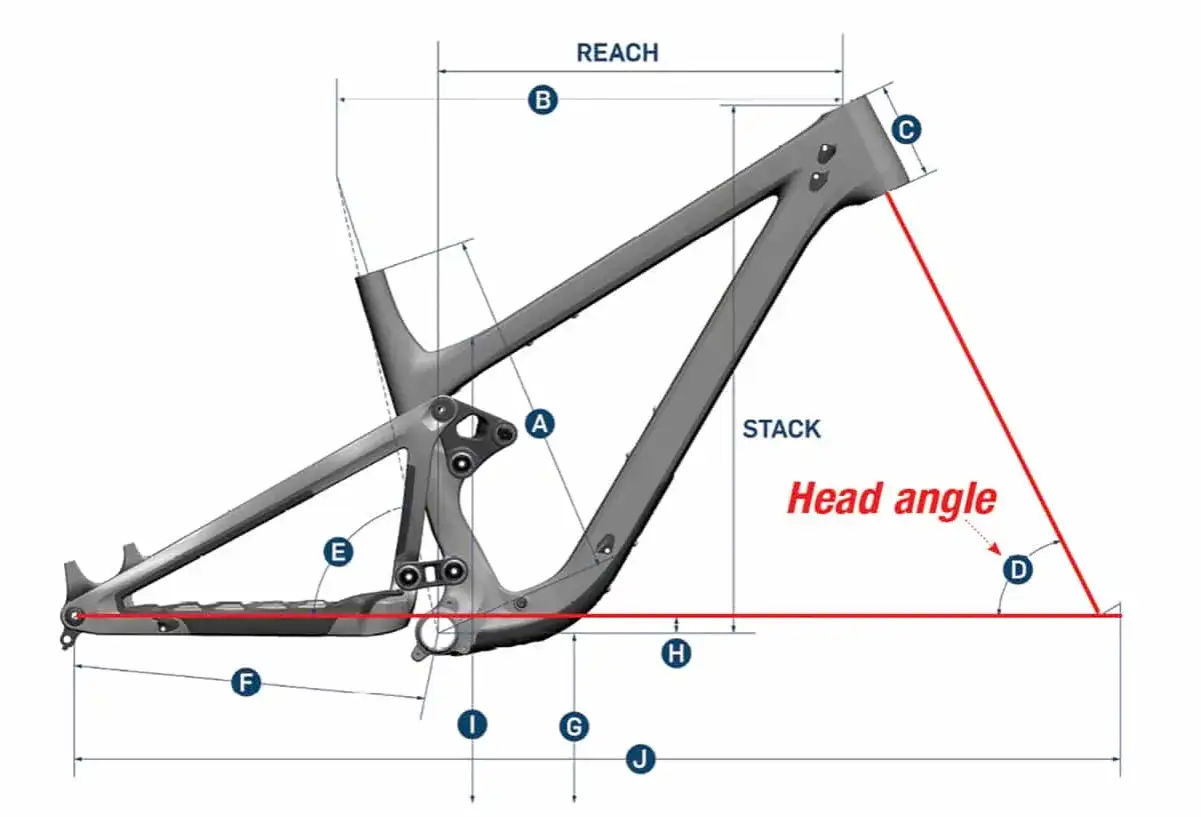
Most geometry charts quote the angle relative to the ground. That means a 65-degree head angle is 65 degrees off the floor, or 25 degrees from vertical. Some riders casually flip the reference line when they talk about it, so I always check the chart legend before I compare bikes.
A slacker front end moves the axle farther out in front of the rider and usually stretches the wheelbase. That tends to calm the bike down when the terrain gets rough or the speed climbs, but it also slows the steering a little when you need to change direction quickly. A steeper front end does the opposite: it keeps the bike feeling lively, makes low-speed turns easier to initiate, and helps on punchy climbs, but it can feel nervous when the trail gets steep and fast.
That basic tradeoff is why the same bike can feel brilliant on one trail and slightly wrong on another. The next step is figuring out what range is typical for each style of mountain bike.
Slack, steep, and the ranges riders actually see
The useful part of a geometry chart is not the exact decimal place. It is where the bike sits in its category. These are the ranges I think of as current, practical benchmarks for modern mountain bikes.
| Bike type | Common head angle | What it usually feels like | Best suited to |
|---|---|---|---|
| XC race | 67-70 degrees | Quick, efficient, and easy to place at low speed | Climbing, marathon days, rolling terrain |
| Trail | 64.5-67 degrees | Balanced and adaptable without feeling lazy | Mixed singletrack and one-bike setups |
| Enduro | 62.5-65.5 degrees | Calm and composed when the trail gets steep or rough | High-speed descending, bigger hits, bike park laps |
| Downhill / park | 62-64.5 degrees | Very stable, with slower steering response | Lift-served riding and aggressive descents |
Those bands overlap for a reason. A 65.5-degree trail bike and a 65.5-degree enduro bike will not necessarily ride the same, because the rest of the geometry changes with the category. When I compare bikes inside the same class, I care more about how far inside or outside the category norm a frame sits than I do about the raw number itself. That leads straight into the part most riders miss: the angle is only one piece of the front end.
Why the same angle can feel different on two bikes
The head angle does not live alone. Reach, fork offset, wheel size, and suspension travel all change the way the front end loads up, so I never judge the number in isolation.
Reach and front-center
Reach is the horizontal distance from the bottom bracket to the top-center of the head tube, and front-center is the distance from the bottom bracket to the front axle. A longer front-end layout gives your hands and body more room to work, which often makes a slack bike feel less awkward on climbs and less twitchy in fast turns. A short reach can make even a moderate angle feel busy because your weight is sitting too far forward. In practice, a 15-30 mm change in reach can matter just as much as half a degree of head angle.
Fork offset
Fork offset is the distance between the steering axis and the front axle. Shorter offset usually adds a more planted, self-centering feel; longer offset usually quickens steering. That is why two bikes with the same printed angle can turn very differently, especially once you add a long-travel fork. I see this as fine-tuning, not magic: offset changes the feel at the front wheel, but it does not rescue a badly matched frame.
Wheel size and fork travel
A 29er typically carries speed and smooths out hits better, which can make a slacker front end feel more manageable. A 27.5 bike often feels a touch easier to flick through tight turns. Fork travel matters too, because a longer fork axle-to-crown height generally slackens the bike a bit and raises the front, while sag under rider weight usually makes the effective angle a little slacker than the catalog number. This is one reason modern geometry charts are more useful when you read them as a system, not as a single line item.
Sag and the real riding position
On a full-suspension bike, the angle you read in the spec sheet is not the angle you always ride. Once the fork and rear suspension settle under rider weight, the front end usually sits a little lower and the effective head angle becomes a touch slacker. That is normal, but it is also why a bike that looks moderate on paper can feel more confident on the trail than the number suggests.
Once you look at those factors together, the chart starts to make more sense. The next question is simpler: which angle suits the way you actually ride?
How I choose the right angle for the riding I actually do
If I’m helping someone pick a bike, I start with the terrain, not the brand’s marketing language. Head angle should match the speed of the trails, the steepness of the descents, and how much confidence the rider wants the front wheel to give back.
XC and marathon riding
For fast climbing, pedaling efficiency, and tight, rolling trails, I usually want a steeper front end, often around 67-70 degrees. That range makes the bike easier to place at low speed and easier to keep lively on long days. It is also the least forgiving choice when the route gets rough and steep, which is why pure race bikes can feel demanding if you point them at chunkier descents.
Trail riding
For a one-bike quiver, I usually land in the mid-60s. Around 65.5-67 degrees is a very practical place to live because it keeps the bike quick enough for local loops without making it nervous when the trail opens up. This is where reach and bar setup matter a lot, because a well-balanced trail bike can feel more confident than a slacker bike with a cramped cockpit.
Read Also: Mountain Biking Los Angeles - Your Guide to Top Trails & Rides
Enduro and bike park days
If the bike will spend real time in steep, rough terrain, I am comfortable going slacker, often around 62.5-65.5 degrees. That extra calm is useful when speed rises, but it comes with slower steering and a little more effort in tight switchbacks. I would only chase the slack end of the range if the riding truly rewards it, because a bike that is too relaxed for your local trails can feel like overkill on every slow turn and punchy climb.
When I narrow it down this way, the number becomes easier to read, because it is tied to actual terrain instead of abstract aggressiveness. That leads directly to the question of whether you can change the angle you already own.
How to change the feel of an existing bike
Sometimes the answer is not buying a new frame. A compatible angle-adjust headset can usually change the front end by about 1 degree, and some bikes use flip chips or linkage settings that move the bike a little steeper or slacker while also changing bottom bracket height. Those changes are worth considering if the frame is close but not quite right.
If I want a bigger change, I look at fork axle-to-crown height, fork offset, or even wheel size. A longer fork can slacken the bike, but it also raises the front and alters weight distribution. That is why I treat fork swaps as geometry changes, not just suspension upgrades.
The limits matter. A tweak of 1 degree can be noticeable, but it will not turn an XC frame into a long-travel sled. Beyond that, you are usually better off choosing a different frame than forcing one bike to do everything. The next section covers the mistakes that make people expect too much from the number.
The mistakes that make head-angle advice useless
The biggest mistake is comparing bikes by one number and pretending the rest of the geometry does not matter. I see that all the time with riders who want the slackest possible front end, then end up on a bike that is too long, too low, or too sluggish for their trails.
- Comparing bikes from different categories as if the same angle means the same handling.
- Ignoring reach and front-center, which often change the fit more than half a degree of head angle.
- Forgetting sag, especially on full-suspension bikes, where the effective angle under load is usually slacker than the spec sheet suggests.
- Assuming slacker is always better, even on tight, low-speed, climb-heavy terrain.
- Copying a pro enduro setup for a local network of short climbs and switchbacks.
My rule is simple: if the bike feels wrong at low speed and still wrong when the trail gets rough, the issue is probably the whole front-end package, not the head angle by itself. That is the lens I use in the final section when I sanity-check a geometry chart.
What I check before I trust a geometry chart
Before I get excited about a head angle number, I want to see five things working together: the angle itself, reach, front-center, fork offset, and the fork travel the bike is actually built around. When those line up, the bike usually feels composed in the right places and lively in the right places too.
- Head angle for steering character.
- Reach and front-center for body position and stability.
- Fork offset for fine-tuning steering response.
- Fork travel and sag for the real riding position, not just the showroom number.
- Your terrain for deciding whether calm or quick handling matters more.
In practice, the best mountain bike is the one whose numbers support the trails you ride most often. If the angle, cockpit, and suspension travel all point in the same direction, the bike will feel right early and stay predictable when the trail gets rough.