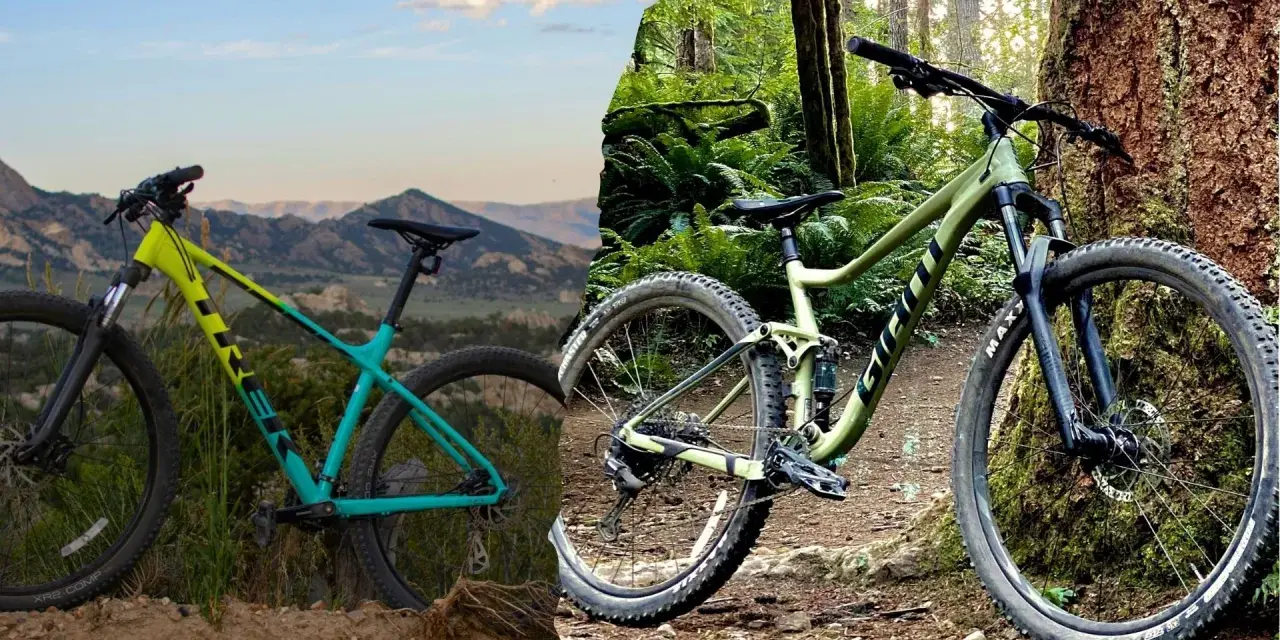
Match the bike to your roughest regular trail
- Hardtails are lighter, cheaper, and simpler to keep running.
- Full-suspension bikes add traction and comfort when the trail gets rough.
- Smooth singletrack, fire roads, and XC rides usually favor a hardtail.
- Rocks, roots, steep descents, and long technical days favor full suspension.
- Most buyers should budget for service, not just the sticker price.
What the two setups change on the trail
The mechanical difference is simple, but the ride difference is not. A hardtail has only front suspension, so the rear wheel is fixed to the frame; a full-suspension bike adds a rear shock to help the back wheel move over bumps instead of bouncing through them. In plain English, the rear end either follows the trail or fights it. REI’s comparison gets to the point: full-suspension bikes cost more and ask more of you financially, but they also bring more comfort and control when the ground gets rough.
Travel is the amount a suspension system can compress. More travel usually means more comfort and control on rougher trails, but it also adds weight, complexity, and cost. Less travel usually feels quicker and more direct, especially when the trail is smooth enough that extra damping starts to feel unnecessary.
| Factor | Hardtail | Full suspension |
|---|---|---|
| Rear end | Rigid | Rear shock absorbs bumps |
| Weight | Usually lighter | Usually heavier |
| Cost | Lower | Higher |
| Maintenance | Less involved | More service points |
| Trail feel | Direct and efficient | Planted and forgiving |
The big idea is this: a hardtail gives cleaner feedback, while a full-suspension bike gives you a bigger margin for error. Once you know that baseline, the more useful question is how those differences show up when the trail tips up or gets rough.
How they feel on climbs, descents, and long rides
On smooth climbs, a hardtail often feels quicker because the bike is lighter and less energy disappears into suspension movement. That is the kind of climb where every pedal stroke feels honest. On rough climbs, though, a full-suspension bike can be faster in real life because the rear wheel stays glued to the ground better, so you waste less time spinning out or fighting for traction. Modern suspension also does a better job of limiting pedal bob, the unwanted up-and-down motion that used to make full-suspension bikes feel lazy on climbs.
Descending is where the gap usually opens up. A full-suspension bike keeps the rear wheel tracking the ground, which improves grip on rocks, roots, braking bumps, and loose turns. It also takes a load off your hands, elbows, and lower back on long descents. A hardtail can still descend well, but it asks for cleaner line choice, better body position, and more commitment from the rider.
For long rides, the difference is often fatigue rather than speed. On a two-hour loop with repeated chatter, a full-suspension bike can save a surprising amount of energy because it filters out the small hits that slowly wear you down. On smoother loops, that advantage shrinks fast, and the simpler bike starts to feel better again. That is why the next question is not abstract at all: it is about the kind of terrain you actually ride every week.
When a hardtail is the better call
I still like hardtails a lot, and not just for beginners. They make the most sense when your local riding is mostly smooth to moderately rough, when you care about weight and cost, or when you want a bike that teaches cleaner technique. A hardtail makes sloppy line choice obvious, which is exactly why many riders get better faster on one.
- If your home trails are mostly hardpack, smooth singletrack, or fire roads, a hardtail is usually enough bike.
- If you ride cross-country, fitness loops, or marathon-style events, the direct power transfer is a real advantage.
- If you want the best bike for the money, a hardtail usually lets more of your budget go into brakes, wheels, and drivetrain instead of rear shock hardware.
- If you ride pump tracks, jump lines, or playful local loops, the rigid rear end can feel lively rather than harsh.
- If you want lower maintenance and fewer parts to service, a hardtail is easier to live with.
I also think hardtails are underrated for mixed riding and bikepacking on forest roads, doubletrack, and smoother dirt. You get enough front suspension for comfort, but you keep the bike simple, efficient, and easy to pack. If your weeknight ride is mostly flowy singletrack and your biggest complaint is budget, a hardtail is not a compromise as much as it is the smarter tool. The point where that changes is when the trail starts punishing your hands, feet, and braking control more than your legs.
When full suspension earns the extra cost
Once the trail gets rocky, rooty, steep, or fast, full suspension stops being a luxury and starts doing actual work. The rear wheel can move instead of skipping across obstacles, which improves traction on technical climbs and keeps the bike calmer on rough descents. Canyon’s current guidance reflects what I see on the trail too: most riders in most terrain end up happiest in the 120 to 150 mm travel range, because it balances climbing and descending better than the extremes.
That does not mean more travel is always better. It means more travel is better when the terrain asks for it. A short-travel XC bike can feel sharp and quick, while a longer-travel trail bike gives you more room to make mistakes when the terrain gets loose or chaotic. The key is to match the bike to the terrain density, not the headline number.
| Travel | Typical feel | Best fit |
|---|---|---|
| 100-120 mm | Fast, efficient, race-oriented | XC and light trail |
| 120-150 mm | Balanced and versatile | Most trail riders |
| 150 mm and up | More composed at speed | Enduro, bike park, steep descents |
I recommend full suspension sooner if you have back or joint issues, ride long descents often, or simply want less fatigue at the end of the ride. The extra comfort is not just about feeling plush; it can keep your body fresher and your mistakes smaller. That brings us to the part most buyers underestimate: the money does not end at checkout.
What the real ownership cost looks like
As a practical US budget rule, I think of hardtails as the lower-cost path into mountain biking and full-suspension bikes as the more expensive but more capable option on rough terrain. The sticker price is only the first difference. The second difference is that full-suspension bikes carry more hardware, more moving parts, and more service needs over time.
| Budget band | Hardtail | Full suspension |
|---|---|---|
| Entry level | About $750-$1,500 | About $1,500-$2,800 |
| Serious enthusiast build | About $1,500-$3,000 | About $3,000-$5,500 |
| Premium | $3,000 and up | $5,500 and up |
I usually budget roughly $150-$300 a year for a regularly ridden hardtail and $300-$700 a year for a full-suspension bike, depending on miles, mud, and whether suspension service comes due. That is not a hard rule, but it is close enough to stop people from pretending the rear shock is free. On a hardtail, your money tends to go farther into better tires, better brakes, and a lighter or more reliable parts mix. On a full-suspension bike, I would rather see solid suspension setup and good maintenance than a fancy frame with neglected pivots and a poorly tuned shock.
If you want the biggest performance gain for the least money, I would often choose a better hardtail over a weak full-suspension build. If you are already sure your trails need rear suspension, then I would rather save a little longer and buy the right full-suspension bike than settle for one that feels heavy, flexy, or under-specced. That is where the decision becomes less emotional and more practical.
The decision gets easier when you buy for real trails, not ideal trails
When I help riders choose, I use a simple rule: buy for the roughest trail you ride every week, not the hardest trail you might ride once in a while. That single filter prevents most bad purchases. A lot of riders talk themselves into extra suspension because one local park lap felt brutal, then spend the rest of the season dragging around a bike that is more expensive than their terrain requires.
- Choose a hardtail if your riding is mostly smooth, you care about value, or you want a bike that feels efficient and direct.
- Choose full suspension if your regular trails are rough enough that traction, comfort, and control matter more than lowest weight.
- If you are stuck between them, I would lean hardtail for smoother XC and mixed-surface riding, and full suspension for technical trail riding and bigger mountain days.
- If you can only own one bike, a balanced trail full-suspension bike around the middle of the travel range is the safer all-rounder for rougher US terrain.
The main mistake is overbuying suspension for terrain that does not need it, or underbuying it for trails that are already asking for more. Match the bike to your actual loop, your actual fitness, and your actual budget, and the choice gets much clearer. If I had to make the decision in one sentence, I would say this: pick the simplest bike that still keeps you fast, comfortable, and in control on the trails you ride most.