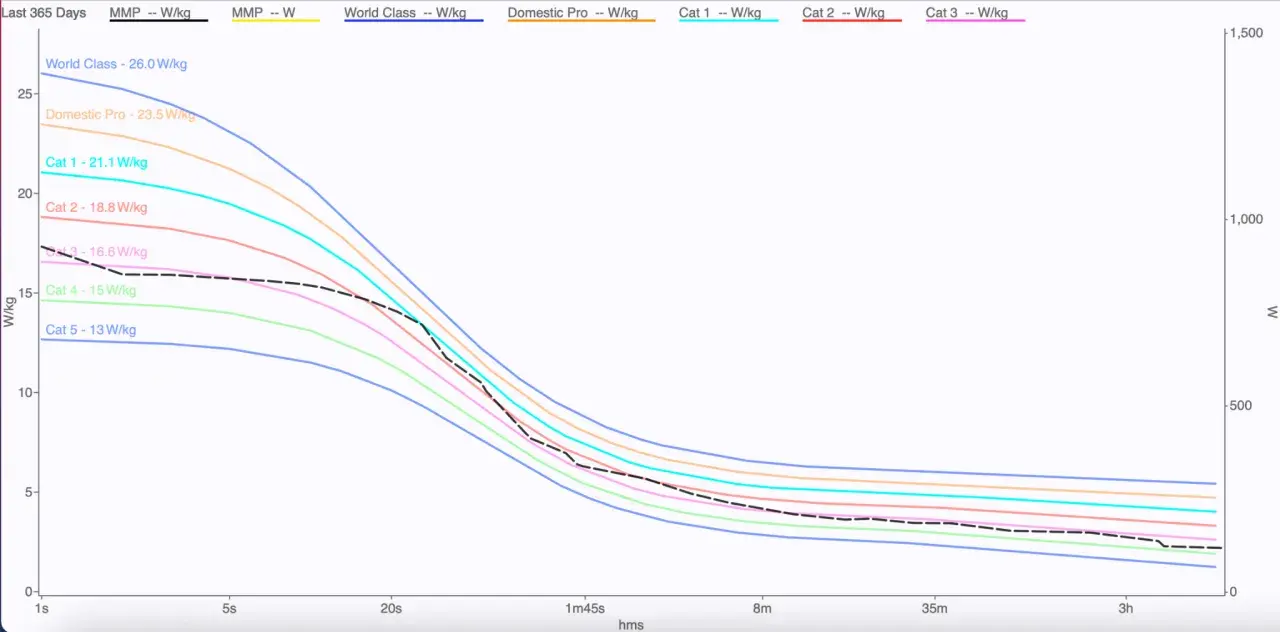
A strong power-to-weight number tells me more about climbing strength and sustained effort than raw watts alone. This article explains how to read a watts per kg chart, what the numbers actually tell you, and how to use the ratio to guide training without mistaking it for the whole story.
The ratio works best as a climbing benchmark
- W/kg = FTP in watts divided by body mass in kilograms. It is the fastest way to judge climbing-oriented fitness.
- The chart matters most for long climbs, steady threshold work, and hilly events.
- On flat roads and in the wind, raw watts and aerodynamics can matter more than the ratio.
- Improving FTP usually pays off faster than aggressive weight loss.
- Track the trend over several weeks, not a single test day.
How I calculate the number and what it actually measures
The math is simple: divide your sustainable power, usually FTP, by your body weight in kilograms. A rider at 280 watts and 80 kg sits at 3.5 W/kg. If you think in pounds, convert first; 180 lb is about 81.6 kg. I like this metric because it gives me a clean read on how much work a rider can sustain relative to size, but it does not tell me everything. It says very little about sprint power, cornering skill, aero position, or race tactics.
One detail matters more than most riders realize: a small change in either side of the equation can move the ratio quickly. At 75 kg, every extra 10 watts adds about 0.13 W/kg. At 60 kg, the same 10 watts adds about 0.17. That is why small FTP gains matter, and why body weight changes can feel much bigger on paper than they do in training. Once the formula is clear, the next step is putting real bands on it.
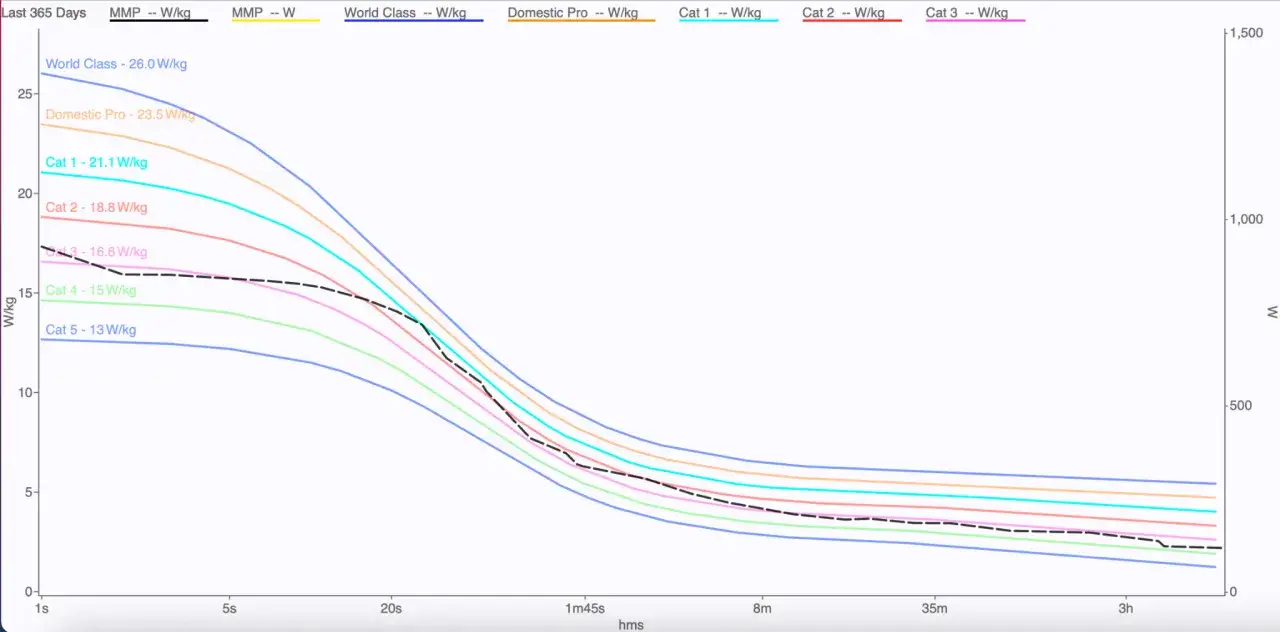
A practical chart for cyclists
I use the bands below as a training lens, not as an official ranking. Different disciplines and rider populations slice the data differently, so I prefer ranges that are useful in day-to-day coaching and self-assessment.
| W/kg range | Practical meaning | What I would expect on the bike |
|---|---|---|
| < 2.0 | Early-stage or returning rider | Good for base riding, but climbs and long surges will feel expensive. |
| 2.0-2.7 | Recreational fit | Comfortable for longer weekend rides and steady group pace. |
| 2.7-3.4 | Trained amateur | Solid all-around fitness and enough power for local hill work. |
| 3.4-4.2 | Competitive amateur | Strong enough to race or climb well in many amateur fields. |
| 4.2-5.2 | Very strong racer | Serious climbing ability and a real edge in hilly events. |
| 5.2+ | Exceptional | Rare outside high-level racing; check your testing method before bragging. |
That upper end lines up with what you see in serious training populations and in published performance discussions, where trained riders cluster much lower than elite climbers and elite racers move well above the middle of the pack. I find that useful because it keeps the chart grounded in real riders, not fantasy numbers. The catch is that the same W/kg can mean something very different depending on terrain and race type.
Why the same number matters more on climbs than on flats
W/kg becomes far more important when gravity is the main obstacle. On a long climb, every kilogram has to be lifted, so a lighter rider with the same sustainable power usually has the advantage. On a flat road, the story changes fast. Air resistance takes over, and raw watts, body position, and bike setup start to matter more than the ratio.
- Best use: long climbs, mountainous gran fondos, steady hill repeats, and indoor climb workouts.
- Less useful: flat criteriums, windy road races, draft-heavy group rides, and sprint finishes.
- Mixed use: rolling routes where both sustained power and aerodynamics matter.
I keep coming back to the same idea: this metric tells me who is likely to climb better, not who is automatically faster everywhere. In a flat race, a rider with more absolute watts and a cleaner aero position can beat a lighter rider with a prettier ratio. That difference matters because it changes the training lever you should pull first.
How I would raise W/kg without chasing a bad bodyweight target
Raise the engine first
If I had to choose one lever, I would usually choose FTP. Structured threshold work, sweet spot, and well-placed VO2 max intervals tend to lift the ratio in a way that supports real riding. Sweet spot is the high-end aerobic work just below threshold, and VO2 max work pushes the top end of your aerobic system. Both help, but they should sit inside a plan that still leaves room for endurance and recovery.
- Use one quality threshold or over-under session each week if recovery is stable.
- Keep at least one endurance ride in the mix so the gains actually stick.
- Do not chase every hard session to failure; repeatable work beats random suffering.
Read Also: 12-Week Cycling Training Plan - Get Fitter, Faster
Trim weight carefully
Weight loss can help, but only if it does not drag power down with it. I am much more interested in sustainable change than in a number on the scale. If a rider at 250 watts drops from 80 kg to 77 kg, the ratio improves from 3.13 to 3.25 W/kg. That is a real gain. But if that same rider also drops to 240 watts because recovery and fueling are too aggressive, the ratio falls back to 3.12. The paper math looks clever; the legs do not.
For that reason, I keep body-composition changes modest and I never cut hard around the workouts that matter most. TrainingPeaks has long made the point that 4 to 4.5 W/kg sits in competitive Category 2 territory and 5 to 6 W/kg reaches elite Category 1 and pro territory, which is a useful reminder that serious progress usually comes from a better engine, a smarter body-composition strategy, or both. If the chart is stuck, the problem is often not effort. It is a week that never gives the body a clear stimulus and enough fuel to adapt.
Common mistakes that make the chart lie
The chart itself is not the problem. The measurement process usually is. I see the same errors over and over: riders compare a fresh FTP with a dehydrated morning weight, use different test protocols from month to month, or judge progress off one weird day instead of a trend. Those habits make the number look more precise than it really is.
- Weigh yourself under the same conditions each time, ideally in the morning before food and after the bathroom.
- Use the same FTP method every time so changes are comparable.
- Do not slash calories while training volume and intensity are high.
- Remember that bike fit, aero position, drafting, and course profile all affect real speed.
- Do not use someone else’s climber number as a personal target if your event profile is flat or tactical.
I would rather see a boring six- to eight-week trend than a dramatic one-day result. Once the measurement is stable, the ratio becomes useful again because it starts describing reality instead of noise. That is what makes it worth using in a real training block.
How I would use this chart in the next four weeks
If I were using this metric with a rider right now, I would keep the process simple. The goal is not to obsess over the scale; the goal is to make the next month of training clearer.
- Week 1: Record FTP and body weight under repeatable conditions, then average a few morning weigh-ins.
- Week 2: Keep one threshold session and one endurance ride, and note whether the power holds cleanly.
- Week 3: If weight loss is part of the plan, keep the deficit mild and protect the quality sessions.
- Week 4: Re-test with the same protocol or compare your best recent efforts under similar conditions.
For most riders, the smartest move is straightforward: build a stronger aerobic engine, keep body mass in a range that does not compromise recovery, and use the ratio to check whether the work is paying off. When the number improves and your climbs, repeats, and long rides improve too, the chart is doing exactly what it should.