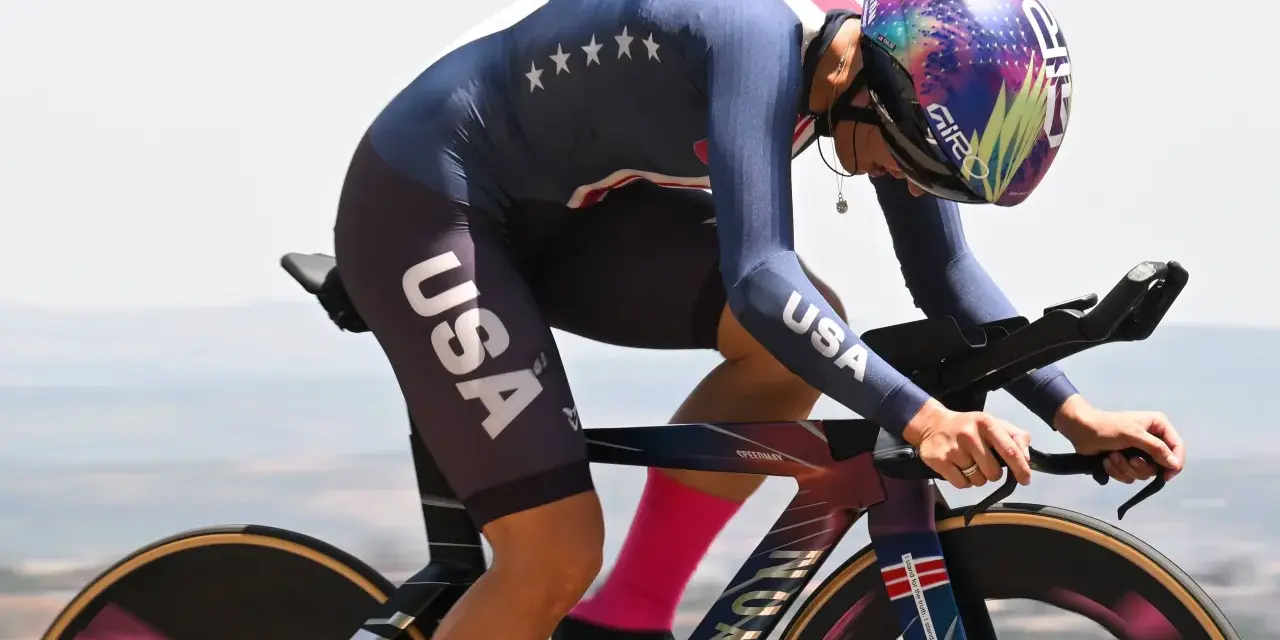
Chloé Dygert is one of the few riders who can make road cycling feel like a power contest and a tactical game at the same time. Her career blends junior road dominance, elite time-trial titles, Olympic medals, and a long stretch of comebacks that have tested both body and mind. Here I focus on what she has actually done on the road, why her style matters, what 2026 has changed, and what serious cyclists can borrow from the way she races.
Why she still matters in 2026
- She is an elite time-trial specialist with one of the deepest sustained power profiles in women’s cycling.
- Her results span junior road titles, elite world titles, and Olympic medals, so her road reputation is built on more than one good season.
- Her 2026 season has been interrupted by health and crash setbacks, which makes context more important than any single result.
- For amateur riders, her story is useful because it shows how much fit, pacing, recovery, and fueling matter.
Why her road profile stands out
I think the easiest mistake is to file her away as “just a track specialist.” That misses the point. She started on the road early, won junior road and time-trial world titles in 2015, and then kept building a record that now spans both disciplines. The numbers alone are hard to ignore: 4 Olympic medals and 10 world titles. What matters to me is how those results are spread across road and track, because that says her road form is backed by a very deep engine rather than a one-season spike.
On the road, that makes her dangerous on flat time trials, rolling courses, and selective races where sustained pressure matters more than pure climbing. In other words, she is not a rider you watch only for flashy attacks. She is the rider who can change the race simply by holding a brutal pace for longer than everyone else can tolerate. That is the kind of profile I always pay attention to in modern road cycling, because it translates across more scenarios than people expect.
That leads naturally into the one quality most fans notice first: her time-trialing.
What makes her time trial style so hard to copy
When I watch her at her best, I see three things working together: sustained power, a calm aero position, and pacing that rarely looks emotional. An aerodynamic position is simply a shape that cuts drag, but it only helps if the rider can hold it without losing power or control. That is where her track background pays off. The same engine that has produced elite road results has also carried her to a 4,000-meter individual pursuit world record ride of 3:15.663, and that kind of output translates directly to the road when the race is a long solo effort against the clock. Threshold, in plain language, is the hardest pace you can hold for a sustained effort without falling apart. Her best road days are built around living close to that line while staying smooth. I think that is the real lesson for anyone trying to understand her success: she is not simply going harder, she is going hard at a pace she can sustain without breaking posture, rhythm, or judgment.For amateurs, the takeaway is blunt. A faster helmet or deeper wheels will not save a position you cannot hold for the full effort. The rider comes first, then the equipment, and only then the marginal gains.
The road results that explain the hype
The hype is easier to respect when you look at the road results in order. Her palmarès is not a random pile of medals; it tells a story about timing, durability, and the ability to turn one specialty into repeatable championship performances.
| Year | Result | Why it matters |
|---|---|---|
| 2015 | Junior road race and time trial world titles | She showed elite road talent before most riders reach the senior level. |
| 2019 | Elite women’s time trial world title | She proved she could beat the best specialists on a major championship course. |
| 2023 | Second elite women’s time trial world title | That win showed the first title was not a one-off and that her form could return after setbacks. |
| 2024 | Olympic bronze in the time trial | She still converted pressure into a podium result on the biggest stage. |
| 2024 | Silver in the elite women’s road race at the UCI Road Worlds | That result reminded everyone she is not only a specialist against the clock. |
I read those results as a pattern, not isolated highlights. She is at her best when the course rewards long, hard pressure, but she is also dangerous when a road race becomes attritional and every late move needs enormous power to stick. That combination is rare, and it is why her name stays relevant whenever the road calendar turns toward championships.
The next question is less about talent and more about context: what has 2026 actually meant for her?
What 2026 has tested
2026 has been a different kind of season. Recent reporting has pointed to DNFs early in the year, a crash at Paris-Roubaix, and then a broader health picture that included RED-S, a virus, and surgery needs after the Roubaix shoulder damage and a collapsed nasal valve. I treat that as a health story first and a performance story second. When a rider of this level struggles across several races, the problem is often not motivation; it is that the body is not ready to convert training into race speed.
RED-S, or Relative Energy Deficiency in Sport, is what happens when the energy budget stops matching the work load for long enough that recovery and performance start to suffer. I bring that up because it changes how I interpret bad results. One poor day can be noise. A run of weak racing across different events is usually a sign that something deeper is going on.
That is why I would not overreact to one result sheet. The bigger question is whether she can string together uninterrupted weeks of training and racing again. If she does, her ceiling still changes the conversation in American road cycling. If she does not, her value as a benchmark remains, but the calendar will keep demanding patience.
What road cyclists can borrow from her training mindset
If I strip the story down to something useful for non-professionals, I keep coming back to four habits: pacing discipline, repeatable threshold work, recovery, and fueling. The pro version is obviously more intense, but the logic is the same for a serious amateur.
| Lesson | What it means in practice | Common mistake |
|---|---|---|
| Build power you can hold | Use sustained efforts, often in 15 to 20 minute blocks, to train steady hard output. | Chasing short, explosive efforts and ignoring race pace. |
| Protect your position | Work on a stable, sustainable aero posture before chasing marginal gains. | Copying a pro fit that you cannot comfortably hold. |
| Fuel the work | Arrive to hard sessions with enough energy to actually train, then recover properly afterward. | Treating under-fueling like a shortcut to fitness. |
| Respect recovery | Sleep, easy spins, and rest days are part of the plan, not optional extras. | Stacking hard days until the body starts flattening out. |
| Choose the right races | Pick events that suit your strengths instead of forcing every start. | Racing too often while carrying fatigue or poor form. |
I would sum it up this way: the best pro lesson is not “train more.” It is “build a body and bike setup that can repeat hard efforts without paying for them the next day.” That is far more useful than copying a workout from social media, and it is especially relevant for riders who want to improve their road time trials.
The same logic applies to gear, which is where a lot of amateurs still spend money in the wrong order.
What her bike setup teaches about gear choices
Her style explains why road cycling gear decisions should start with fit, not with the most expensive shiny part on the market. A rider who lives on sustained power gains more from a stable position, dialed-in contact points, and reliable tires than from a setup that looks fast but falls apart after 15 minutes. If I were advising an amateur time-trialist, I would rank the priorities like this: fit, position holdability, pacing tools, then aero upgrades.
- Fit first. If the position is wrong, the watts are harder to access and harder to repeat.
- Holdable aero position. A slightly less aggressive setup that you can sustain is usually faster than a radical one you abandon midway.
- Pacing tools. A power meter or clean split strategy keeps the effort honest when adrenaline rises.
- Stable handling. On rolling courses and in crosswinds, control matters as much as drag reduction.
I think that is the most honest gear lesson in her career: the best equipment is the equipment that lets the rider stay effective when fatigue rises. Wheels, helmets, and cockpit choices matter, but they only matter after the body can actually use them.
That practical lens is the best way to understand why she still matters to American road cycling.
Why she still shapes the American road picture
Even with the interruptions, Dygert still matters because the United States does not have many riders who can legitimately threaten a world title or Olympic podium in a pure time trial and also influence a hard road race. I would keep following her for two reasons: she is a case study in extraordinary power, and she is a reminder that elite form is fragile. If she stays healthy, she can still change a race in a single effort; if she does not, her story still tells you a lot about how much modern road cycling depends on recovery, fueling, and honest pacing.
For fans and amateur riders alike, the most useful takeaway is simple: watch the details, not just the result. Her starts, her position on the bike, and the way she manages the final five minutes of a time trial tell you more than the final placing alone. That is where the real lesson in her road career lives, and it is the part I would keep an eye on through the rest of 2026.