A well-built indoor sprint workout should make you faster without turning the session into a sloppy grind. Indoors, every detail matters: the bike setup, the sprint length, the recovery, and the way you pace the last rep. In this guide I break down what the session is really training, how to set up the bike, which sprint format fits your goal, and how to use the work without overcooking your week.
What matters most before you start
- Keep the reps short. For true top-end work, 8 to 12 seconds is usually the sweet spot.
- Recover fully. Sprint quality drops fast when the rest periods are too short.
- Set up the room first. A fan, water, and a stable bike matter more than fancy software.
- Track power or cadence. Heart rate lags too much to judge a sprint set on its own.
- Stop while the form is still clean. A great sprint session ends with sharp reps, not a survival shuffle.
The fastest gains come from a few clean, repeatable efforts
When I program sprint work indoors, I am usually chasing three things: neuromuscular power, anaerobic punch, and the ability to repeat hard accelerations without falling apart. Neuromuscular power is simply your nervous system learning to recruit more muscle fibers faster, which is why short, explosive reps can change how a rider feels on group rides, climbs, and race starts.
That is also why this kind of session should not feel like a long burn. If the workout turns into a 20-minute misery test, the quality of the sprints is already fading. I want the hard efforts to stay sharp enough that I can compare rep one to rep six and still see a useful signal. That distinction matters, because the next step is making the bike itself support that quality instead of getting in the way.
Set up the bike so the sprint stays clean
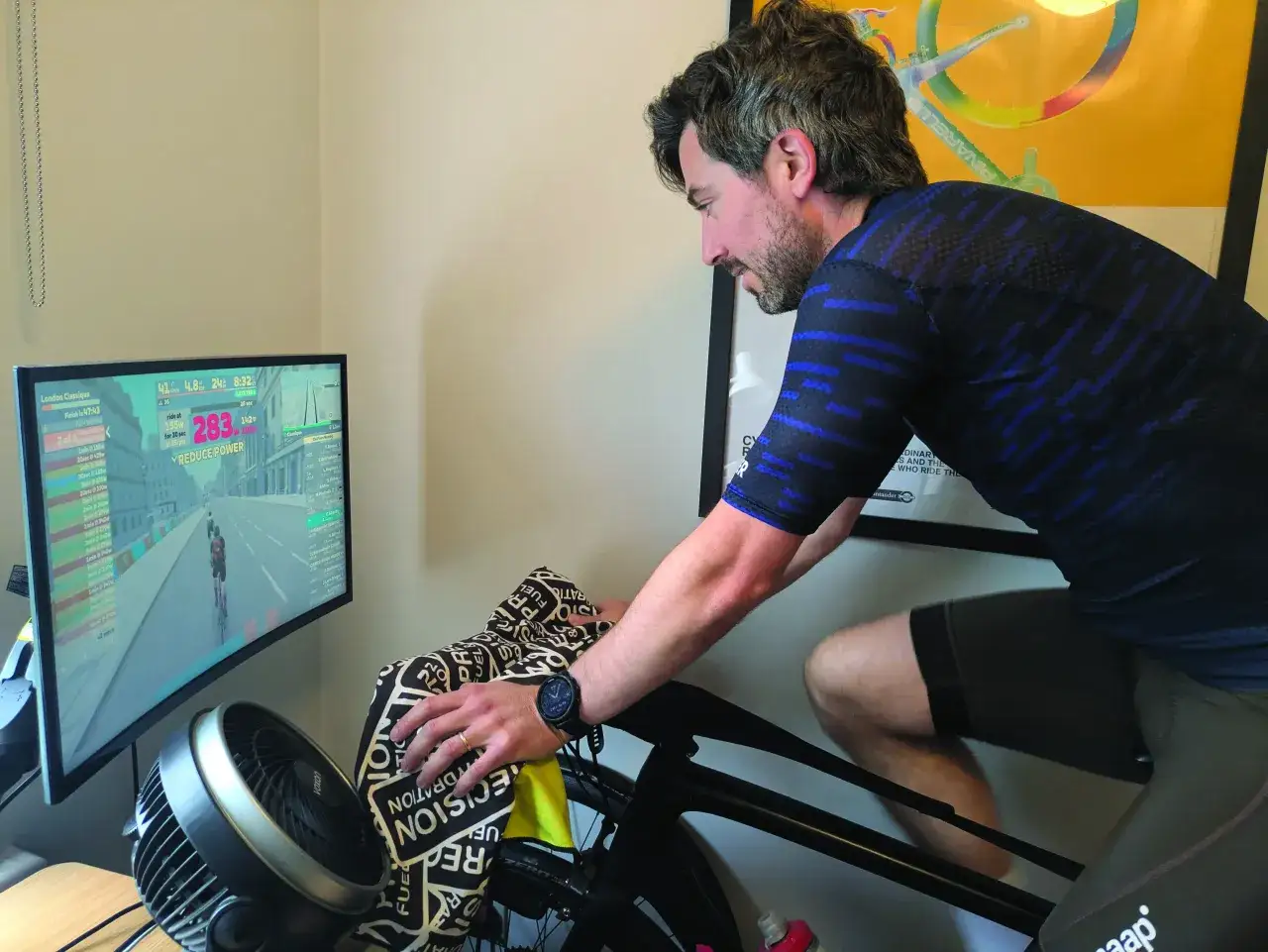
Indoor sprinting exposes every weak link in your setup. If the bike rocks, the trainer slips, the room is hot, or the resistance is mismatched, you waste energy that should be going into the pedals. I always start with the basics before I touch the workout file.
- Use a fan. A strong fan is not a luxury indoors; it is performance equipment.
- Stabilize the bike. If the frame moves around, your output and confidence both suffer.
- Keep water within reach. Short sprints still generate a lot of heat, especially in a warm room.
- Choose the right mode. On a smart trainer, I usually avoid erg mode for maximal sprints because it can fight acceleration.
- Pick a resistance that lets you accelerate. Too little load and you spin out immediately; too much and you turn the sprint into a grind.
I also like to warm up longer than most riders expect. Ten to fifteen minutes is a better floor than a luxury for hard indoor work, and I build in a few short spin-ups so the legs wake up before the real effort starts. Once the setup is right, the main question becomes which sprint format actually matches the goal.
Use the right sprint length for the goal
Not every hard interval is a sprint. In practice, the difference is simple: the shorter the effort, the more it trains pure acceleration and top-end power; the longer it runs, the more it turns into anaerobic conditioning. That is useful too, but it is a different job.
| Sprint length | Recovery | Best use | What I watch |
|---|---|---|---|
| 8 to 12 seconds | 2.5 to 4 minutes easy | Pure power, acceleration, leg speed | Fast start, stable torso, repeatable peak output |
| 20 to 30 seconds | 2 to 4 minutes easy | Anaerobic capacity and hard race-like efforts | How quickly power drops after the first burst |
| 45 to 60 seconds | 3 to 5 minutes easy | Power endurance and pain tolerance | Whether this is still a sprint or has become a threshold drill |
If I want a cyclist to feel snappier, I usually keep the reps short and the recovery generous. If the goal is more of a fight than a jump, then longer intervals make sense. That choice shapes the whole workout, so now I will lay out a session that stays honest about what it is trying to do.
A 30-minute session I would actually ride
This is the kind of session I would use for an indoor bike, a smart trainer, or a solid spin bike. It is short enough to stay focused, but it still gives enough volume to produce a meaningful training effect.
| Segment | Time | Effort | Purpose |
|---|---|---|---|
| Warm-up | 10 minutes | Easy to moderate | Raise temperature, loosen hips, bring cadence up gradually |
| Openers | 3 x 15 seconds | Fast but not all-out | Wake up the legs without burning matches |
| Main set | 6 x 10 seconds | All-out sprint | Train peak power and acceleration |
| Recovery between sprints | 3 minutes easy | Very light spinning | Let the nervous system reset so the next rep stays sharp |
| Cool-down | 5 to 8 minutes | Easy spin | Bring the session down cleanly |
I prefer keeping the body position consistent through the whole set, either seated or standing, so I can compare the reps cleanly. If you mix positions randomly, the data gets messy and the session becomes harder to judge. On a power meter, I care more about repeatability than one hero number, because the best sprint session is the one you can repeat with quality.
How to scale the session by level
Most riders do not need a brutal workout to get value from sprint work. They need the right dose, the right rest, and enough restraint to stop before quality collapses. This is how I usually scale it.
| Level | Main set | Total hard work | Notes |
|---|---|---|---|
| Beginner | 4 x 8 seconds | 32 seconds | Use longer recovery and stop early if coordination gets messy |
| Intermediate | 6 x 10 seconds | 60 seconds | Good default for riders who already tolerate intervals well |
| Advanced | 2 sets of 4 x 10 to 12 seconds | 80 to 96 seconds | Only useful if output stays high across both sets |
If you are new to this kind of work, I would rather see four high-quality sprints than eight mediocre ones. That sounds conservative, but it is how real progress usually happens. Once the session is scaled correctly, the next risk is not undertraining; it is doing the wrong things inside the workout.
The mistakes that blunt power indoors
Most bad sprint sessions are not caused by lack of effort. They are caused by small pacing and setup errors that quietly flatten the quality of the work.
- Starting cold. Hard efforts without a real warm-up usually feel awful and produce worse power.
- Using too much resistance. If you are grinding from the first second, the sprint has already lost its shape.
- Resting too little. Short recovery turns a sprint set into a fatigue test.
- Chasing heart rate. Heart rate rises too slowly to guide a maximal sprint set in real time.
- Letting every rep become longer. If the effort drifts from 10 seconds to 25 seconds, the training target changed without permission.
- Doing too many hard days. Sprint work only pays off when the rest of the week still supports it.
I also think indoor riders sometimes underestimate heat. A warm, still room can shave power off the back half of the session faster than they expect. If the fan is weak, the workout feels harder for the wrong reason. That is why the weekly context matters as much as the session itself, and the next section is where that gets decided.
Where this fits in a weekly cycling plan
For most healthy riders, one sprint-focused session a week is enough to start. Two can work, but only if the rest of the week is not already packed with hard riding, strength training, or long rides that leave the legs flat. I usually keep at least 48 hours between hard sessions if the goal is to preserve quality.
- Base phase. One sprint day plus mostly easy endurance work is often the cleanest combination.
- Build phase. One sprint day and one threshold or VO2 session can work well if recovery is solid.
- Busy week. If the legs are stale, skip the sprint session rather than forcing a poor one.
In practice, I like sprint work best when it sits next to easier days, not sandwiched between two hard ones. That preserves the freshness that true power work needs, and it also makes the final numbers easier to trust.
The details I keep track of after the ride
After the session, I do not obsess over total fatigue. I look at a few simpler markers: peak power, how much that peak drifted across the set, whether cadence stayed controlled, and whether the sprint still felt technically clean near the end. If the best rep and the last rep are too far apart, the session was probably too long for the current condition.
My personal rule is straightforward: if the output falls sharply or the body position starts breaking down, I stop chasing more reps. That is the difference between useful sprint training and just collecting soreness. If you keep the room cool, the bike stable, the reps short, and the recovery honest, the work will do what it is supposed to do: make your indoor riding faster, sharper, and more responsive without wasting energy on noise.