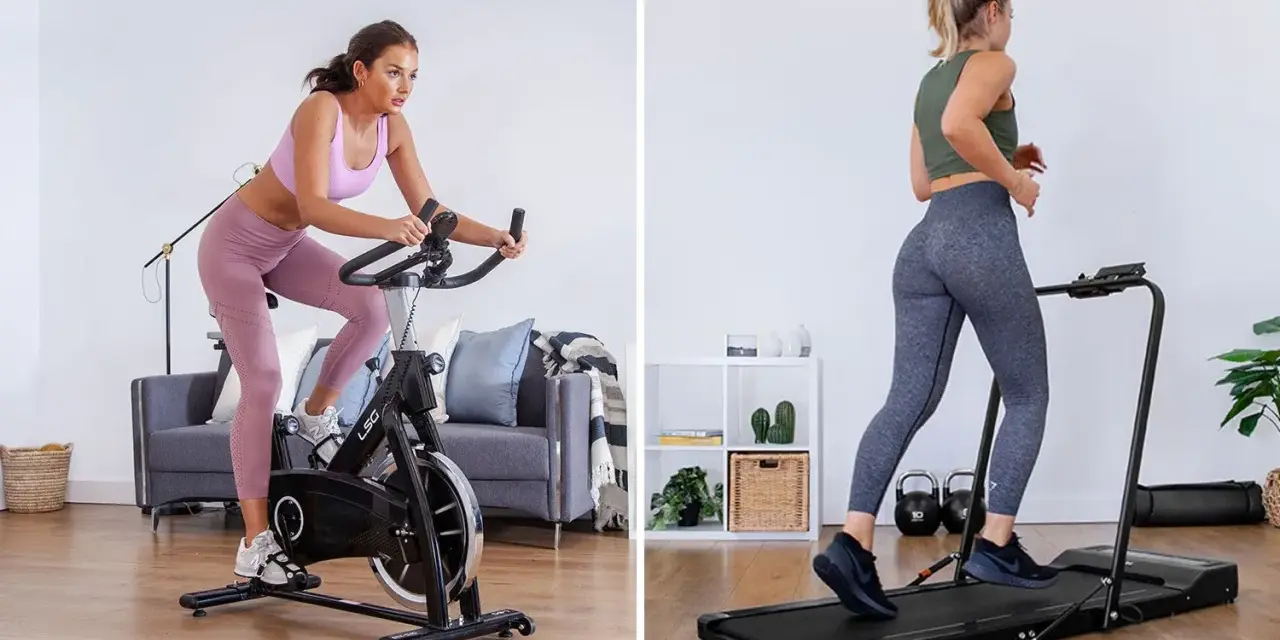
The better choice depends on whether you want lower impact or more weight-bearing work
- Choose the bike if your priority is joint comfort, recovery, indoor cycling specificity or longer sessions you can sustain.
- Choose the incline treadmill if you want standing cardio, more glute and calf loading, and a walking pattern that carries over to hills and hiking.
- Calorie burn is effort-driven, but the bike often lets people work hard with less joint irritation.
- Bone loading matters: walking uphill is weight-bearing, while cycling is not.
- Consistency beats machine loyalty; the one you will actually use three to five times a week usually wins.
What each machine asks your body to do
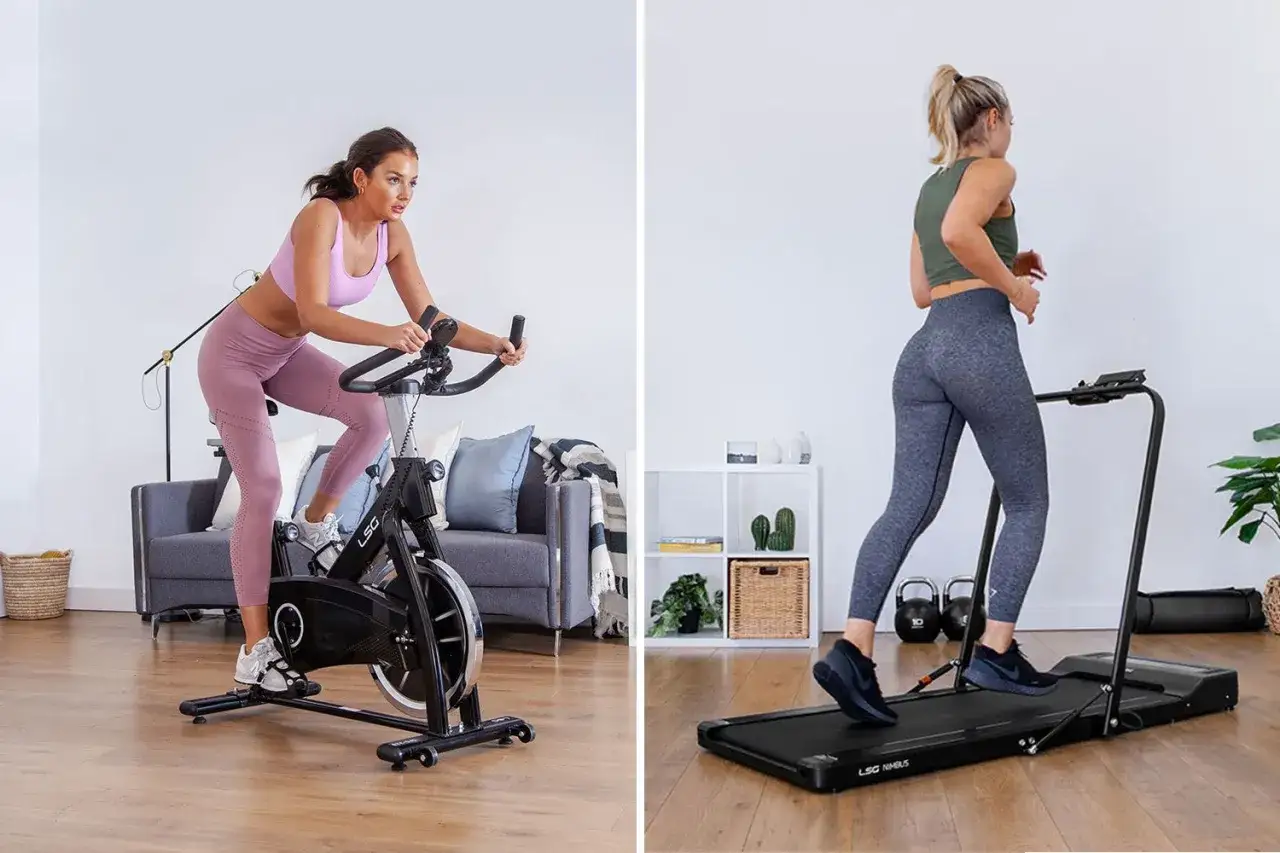
The stationary bike keeps you seated, so your legs produce force without absorbing much impact. That makes it a clean choice for aerobic work, cadence practice and interval training, especially if you want to stay close to the movement pattern of real cycling. The trade-off is that it is mostly a lower-body, non-weight-bearing effort, so it does less for bone-loading than walking.
An incline treadmill changes the picture immediately. You are standing, supporting your body weight and repeatedly pushing against gravity, which shifts more work into the glutes, hamstrings, calves and the small stabilizers around the hips and trunk. It also asks a little more from balance and posture, which is one reason it can feel more demanding even when the speed looks modest.
That difference explains why the calorie picture is not as simple as one machine always beating the other. The machine matters less than the combination of posture, resistance, incline and how hard you are actually breathing.
How they compare on calories and effort
I like to separate this into two layers: what happens at a moderate steady pace, and what happens once you push the intensity. Harvard Health’s calorie chart gives a useful baseline here. For 30 minutes of moderate stationary biking, the burn is about 210 calories for a 125-pound person, 252 for a 155-pound person and 294 for a 185-pound person. Flat walking is lower at the same duration: about 107, 133 and 159 calories at 3.5 mph, or 135, 175 and 189 calories at 4 mph.
| Factor | Stationary bike | Incline treadmill |
|---|---|---|
| Impact on joints | Very low impact and usually easier on knees, hips and ankles | Still lower impact than running, but more demanding because you are weight-bearing |
| Typical calorie feel | Predictable, and easy to scale with resistance and cadence | Highly dependent on speed, grade and whether you hold the rails |
| Moderate 30-minute burn | 210 / 252 / 294 calories at 125 / 155 / 185 lb | Flat walking is 107 / 133 / 159 calories at 3.5 mph and 135 / 175 / 189 at 4 mph; incline raises the demand quickly |
| Main muscles | Quads, glutes, hamstrings and calves, with limited posture demand | Glutes, hamstrings, calves, core and the stabilizers that keep you upright |
| Best use case | Indoor cycling, recovery days, longer steady cardio, pain-free intervals | Walking fitness, hill prep, hiking prep, weight-bearing conditioning |
Harvard Health also notes that incline walking increases muscle activity because you are working against gravity, so the treadmill gets much harder as the grade rises. In practice, that means a steep incline can close the gap fast, but only if you actually walk the hill rather than lean on the handrails and turn it into a supported shuffle. That is the detail many people miss.
My short version: the bike tends to give you more work with less irritation, while the incline treadmill gives you more standing, more loading and more carryover to real-world walking or hiking. Once the effort picture is clear, the next question is which machine fits your body and your training history.
When the stationary bike is the smarter pick
Mayo Clinic is blunt about this: cycling is a great cardio option with minimal stress on the joints. If walking, jogging or repeated impacts bother your knees, hips or feet, the bike often lets you train hard without paying for it the next day. That is why I reach for it first in recovery phases, during busy weeks and for anyone who needs a reliable low-friction cardio habit.
- You have joint pain or are coming back from a flare-up. The seated position usually makes it easier to keep moving without irritation.
- You want indoor cycling transfer. If your main sport is riding, the bike is the more specific tool for cadence, resistance and aerobic base.
- You need longer sessions. It is easier for many people to sit and spin for 40 to 60 minutes than to stay mentally comfortable on a treadmill for that long.
- You want interval work without pounding. Hard bike intervals are often easier to recover from than hill sprints or fast incline walking.
- You want something you can do consistently. For a lot of people, the seated format removes the biggest barrier: getting started.
There is one important limitation, though. Cycling is excellent for aerobic fitness, but it does not provide the weight-bearing load bones need to slow bone loss. If bone health is part of your goal, I would pair the bike with walking, strength training or another weight-bearing activity instead of pretending the bike covers everything. That is where the treadmill starts making more sense.
When an incline treadmill earns the edge
An incline treadmill is the better fit when you want a workout that feels more like uphill walking than seated cardio. It gives you weight-bearing work, which matters for bone health, and it shifts more demand into the glutes and calves than flat walking does. Harvard Health even notes that incline treadmill walking can benefit people with knee osteoarthritis and knee replacements, which tells you that the machine can be useful when it is used intelligently rather than aggressively.
- You want walking-based conditioning. If you like the feel of walking, hiking or hill work, the treadmill keeps the movement pattern natural.
- You want more glute and calf work. The incline adds posterior-chain demand without needing to run.
- You care about weight-bearing exercise. Standing and moving against gravity creates a different training signal than pedaling.
- You are training for hills or hiking trips. The treadmill is one of the best indoor tools for that carryover.
- You dislike sitting for cardio. Some people simply stay more engaged when they are upright and moving forward.
The limitation is that incline work can get sloppy quickly. If the grade is too steep, the speed too fast or the handrail grip too heavy, the session turns into compensation instead of training. I would rather see someone walk at a moderate incline with clean posture than grind through an exaggerated climb with a hunched back and short, tense steps. Once you know the fit, the next step is programming each machine so the session actually does something.
How I would program each machine for real progress
The biggest mistake I see is people choosing a machine they like, then doing a version of it that is too easy to move the needle. A hard machine is not automatically a useful one. I would build the session around RPE, or rate of perceived exertion, which is just a 1-10 effort scale: moderate work usually lives around 5-6, and hard intervals sit closer to 8-9.
A bike session I would actually assign
- Warm up for 5 to 10 minutes at an easy cadence.
- Ride 20 to 40 minutes at RPE 5-6, with enough resistance that your legs are working, not just spinning air.
- Keep cadence for many recreational riders in the 80 to 95 rpm range if that feels smooth and controlled.
- Once a week, add intervals such as 6 rounds of 2 minutes hard and 2 minutes easy.
Read Also: Indoor Cycling vs. Spinning - Which Ride is Right for You?
An incline treadmill session I would actually assign
- Warm up for 5 minutes at flat or 1-2% incline.
- Move into 15 to 25 minutes at a moderate incline, often somewhere around 5% to 10% for many people.
- Hold an intensity where you can still speak in short sentences, not full speeches.
- Progress by adding time or a small incline bump, not by jumping straight to a steep grade you cannot control.
Two details matter a lot here. On the bike, do not confuse light spinning with actual training. On the treadmill, do not let the handrails do the work for you. In both cases, the session should end with a clear training effect, not just a sense that you were busy for half an hour. That brings the choice down to a very practical question: what do you need the machine to do for you week after week?
A simple decision rule that works for most riders
If I had to reduce the whole decision to one sentence, I would say this: pick the bike when comfort, recovery and cycling specificity matter most; pick the incline treadmill when weight-bearing work, walking carryover and hill conditioning matter most. If you are choosing for fat loss alone, either machine can work well enough that adherence matters more than the logo on the console.
- Choose the bike if your knees complain, your schedule is tight or you want to protect your legs between rides.
- Choose the treadmill if you want standing cardio that feels more athletic and more like real-world movement.
- Use both if you can, because they solve different problems and reduce boredom better than forcing one machine to do everything.
If a single machine must earn the spot in your home gym, I would lean toward the bike for most people who want a joint-friendly, repeatable cardio habit. If your main goal is to build walking tolerance, prepare for hills or keep some weight-bearing work in the mix, the incline treadmill has the edge. The best choice is the one that lets you keep showing up without negotiating with pain or boredom every session.