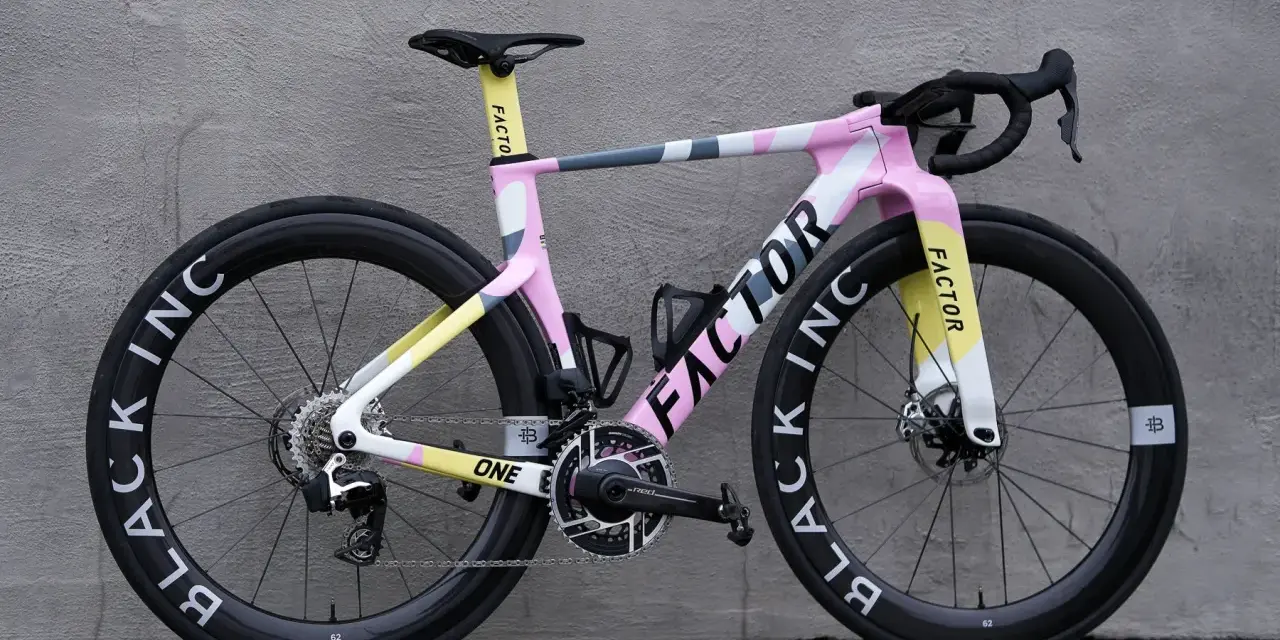
Choosing a performance road bike is really about matching speed to the way you ride. A Factor aero bike only pays off when the fit, tire clearance, and build spec line up with your courses, your body position, and how much maintenance you are willing to live with. In 2026, Factor’s road lineup is clear enough that the decision becomes practical instead of guesswork.
What matters most when choosing a Factor road bike
- ONE is the pure aero choice for sprints, flat races, and rolling roads.
- OSTRO VAM is the best all-round pick if you want one bike to do almost everything well.
- MONZA adds real-world practicality with storage, mounts, and wider tire clearance.
- O2 VAM is the climbing-focused option that still keeps serious aero performance.
- Fit matters as much as speed, especially once you move into integrated cockpits and aggressive geometry.
- Budget is wide, so model choice matters before you start adding premium build options.
How Factor's road lineup breaks into four clear jobs
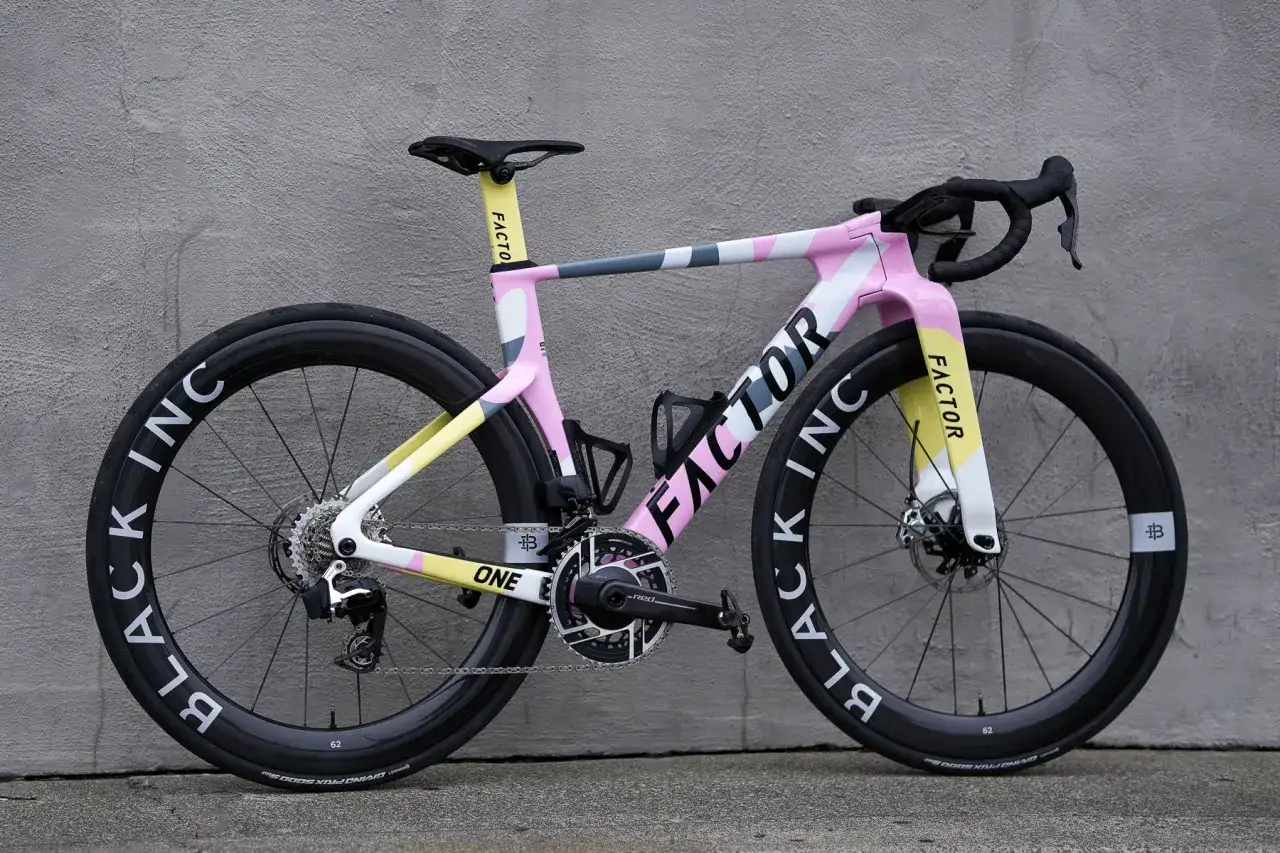
When I look at Factor’s current road range, I do not see a pile of similar bikes. I see four distinct answers to four different riding problems: the ONE for pure aero racing, the OSTRO VAM for all-round speed, the MONZA for practical race performance, and the O2 VAM for climbing with an aero edge. That separation is useful, because it stops the usual mistake of buying the fastest-looking bike instead of the fastest bike for your actual riding.
| Model | Best for | What stands out | Main compromise |
|---|---|---|---|
| ONE | Pure aero racing, sprints, and flat-to-rolling stages | Most aero-focused bike in the range, 34 mm measured tire width support, 47 to 58 cm sizing, and a very aggressive race position | Least forgiving if you want relaxed fit changes or a low-maintenance setup |
| OSTRO VAM | All-round racing and climbing | Sub-7 kg platform, 32 mm measured tire clearance, strong handling balance, and fast enough for almost any road race | Still a serious race bike, so it gives up some practicality to stay sharp |
| MONZA | Training, cobbles, rough roads, and daily use | In-frame storage, light mounts, up to 34 mm measured tire clearance, and a slightly higher stack | Not as extreme or as light as the flagship aero machines |
| O2 VAM | Climbing days and mountain races | About 6.4 kg out of the box in one build, still aero enough to matter, and 10 mm higher stack than the previous version | Specialized for elevation, not the first bike I would choose for flat sprint-heavy racing |
The useful takeaway is simple: Factor is not trying to make one bike do everything by force. It is giving each rider type a cleaner tool. That matters, because the next question is not which bike is best on paper, but which one fits the courses you actually ride.
Which model matches your course profile
If your riding is mostly criteriums, fast group rides, flat races, and rolling terrain, the ONE is the sharpest answer. It is built for riders who care about aerodynamic advantage first and accept that the position is part of the performance package. I would also put it high on the list for racers who are very sensitive to speed at the front of the bike and want the most aggressively modern road geometry Factor is offering.
If your weeks are more mixed, the OSTRO VAM is the bike I would expect most serious riders to be happiest with. It is the model that lets you race hard on Saturday, climb on Sunday, and still feel efficient when the route turns chaotic. Factor’s own road-range guide positions it as the best all-around road bike, and that matches how I would use it in the real world: one bike, many jobs, very little wasted performance.
For riders in the U.S. who split time between training, racing, and road conditions that are not always perfect, the MONZA is the more pragmatic choice. It keeps the race feel but adds features that actually matter outside a clean race-day photo shoot, and that is the difference between a bike you admire and one you use. The current U.S. catalog is broad enough to prove the point, ranging from a $4,099 MONZA standard package to a $14,199 ONE build, so choosing by use case is smarter than choosing by price badge alone.
In mountain-heavy regions, or for riders who measure success in climbing speed, the O2 VAM makes the most sense. It is the bike for long ascents, mountain fondos, and road races where every gram still matters on the final climb. What I like most is that it does not pretend to be a pure featherweight at the expense of everything else; it keeps meaningful aero shaping, which is exactly why it stays relevant once the gradient eases off.
That course-based filter usually narrows the decision fast, but fit is the piece that decides whether the bike feels brilliant or merely expensive.
Fit details that change the ride
This is where buyers often get it wrong. Aero bikes are not just about drag numbers; they are about whether you can hold the position long enough to benefit from them. On a bike like the ONE, the position is more aggressive by design, so I would check fit before I got seduced by the idea of maximum speed. A few millimeters in the wrong direction can do more damage than a slightly slower wheelset ever will.
Start with stack and reach
Stack and reach tell you how high and how long the front end feels. The ONE comes in five sizes from 47 to 58 cm, with cockpit options that mirror roughly 110 to 150 mm stem lengths, while the O2 VAM raises stack by 10 mm compared with the previous version to help more riders hit a sustainable position. That extra height is not a small detail; it can be the difference between a race fit you can hold for two hours and one you abandon after 45 minutes.
Do not ignore cockpit width and adjustment
The ONE uses 38 mm wide cockpit handlebars, which tells you exactly what kind of bike it is: narrow, streamlined, and aimed at modern aero positions. It also gives riders up to 15 mm of spacer range, which creates a useful 35 mm range in shifter stack height. I would still treat that as a fit tool, not a comfort guarantee, because integrated front ends are much less forgiving than traditional stems once the bike is built.
Read Also: Bike Stack Height - Your Guide to Perfect Fit & Ride
Match tire size to the roads you ride
Factor gives you a clear clue here. The ONE is optimized for up to 34 mm measured tire width, which makes it more versatile than many pure aero race bikes. The OSTRO VAM is optimized around 28 mm tires and allows up to 32 mm measured clearance, which is exactly what I would expect from a race bike that wants to stay quick without becoming bulky. The MONZA also accepts up to 34 mm measured tires, which makes it the easiest option if your roads are rough, patched, or full of chipseal.
If you live somewhere with smooth asphalt and short, explosive racing, tighter aero fit choices make sense. If your local roads are rougher or your position needs to be a touch higher, the more forgiving models are the safer buy. That brings us to the details hidden deeper in the spec sheet.
Where the spec sheet hides the real trade-offs
A lot of buyers focus on frame weight and miss the practical stuff. I think that is backwards. Wheels, storage, mounts, and serviceability often shape the experience more than the headline numbers do, especially once the bike leaves the showroom.
- Wheel intent changes ride feel. The OSTRO VAM ships with Black Inc 48|58 wheels optimized for 28 mm tires, while the O2 VAM uses a lighter 28//33 wheelset built around 28 mm tires. Those are not random choices; they reinforce each bike’s mission.
- Storage can be a speed feature. The MONZA’s in-frame storage fits two tubes, two CO2 cartridges, and a patch kit, and Factor says it can save up to six watts versus a saddle bag. For long rides and self-supported racing, that is a real advantage, not marketing fluff.
- More practical bikes are easier to live with. The MONZA includes mounting options for lights and a UDH-friendly setup, which matters if you commute, train early, or want future drivetrain compatibility without drama.
- Light bikes still need to be race-stiff. The O2 VAM and OSTRO VAM are both built around high-end carbon layups, but the O2 leans into climbing efficiency while the OSTRO stays the more balanced race weapon.
- Integrated parts cut both ways. A one-piece or semi-integrated front end improves aerodynamics, but it makes stem changes, travel prep, and last-minute fit tweaks less convenient. That is fine if your fit is dialed, and annoying if it is not.
The compromise is not that one bike is good and the others are bad. The compromise is always between speed, comfort, and ease of ownership. The best buyers decide which side of that triangle matters most before they order, not after the first long ride.
The choice I would make for different riders
If I had to choose for a real rider and not a spec sheet, I would make it this simple:
- Pick the ONE if your races are flat, fast, and decided by aerodynamics more than climbing.
- Pick the OSTRO VAM if you want one road bike that can handle nearly every serious riding scenario without feeling like a compromise.
- Pick the MONZA if you train a lot, race on rougher roads, commute to rides, or want practical features that do not ruin the bike’s speed.
- Pick the O2 VAM if your main wins happen on climbs and mountain courses, but you still want a bike that does not surrender too much on the flats.
My default recommendation for most competitive riders is still the OSTRO VAM, because it is the safest blend of speed, weight, and handling. I would only move to the ONE if the rider really lives in pure aero territory, or to the MONZA if real-world usability is a daily requirement. If you want the fastest Factor aero bike for your kind of riding, start with the course, then the fit, then the build.