A good power plan turns effort into something measurable. FTP gives you the anchor, but FTP power zones are what tell you whether today should build endurance, sharpen threshold, or add the kind of high-end work that actually changes fitness. In this guide I break down the standard ranges, show how to choose the right zone for the session, and point out the mistakes that quietly make a training week less effective than it looks on paper.
The practical points that matter most before you start riding
- FTP is a working estimate of sustainable power, not a perfect physiological border.
- Most cyclists train from a seven-zone map, from active recovery to anaerobic capacity.
- Zone 2 builds the aerobic base, sweet spot saves time, threshold raises sustained power, and VO2 work lifts the ceiling.
- If your FTP is stale, every zone shifts and the workouts start missing the target.
- Power works best when you still check effort and recovery, especially in heat or on punchy routes.
Why FTP is the anchor, not the whole plan
I treat FTP as a calibration tool. It tells me the approximate power a rider can hold for a long, steady effort, but the real value comes from what that number lets me prescribe afterward. A well-set FTP makes the rest of the week intelligible: easy rides stay easy, threshold work stays meaningful, and hard intervals land where they should instead of drifting into junk intensity.
The part many riders miss is that FTP is not a fixed truth. It changes with fitness, fatigue, training history, heat, equipment, and even how well you pace a test. That is why power zones matter more than the single number itself: they turn one estimate into practical training ranges that I can actually use on Tuesday, Thursday, and Saturday.
That also means the zones are only as good as the anchor underneath them. If the anchor is old, the plan starts to wobble, and the next step is to look at the actual zone ranges you will train from.
The zone map most cyclists actually use
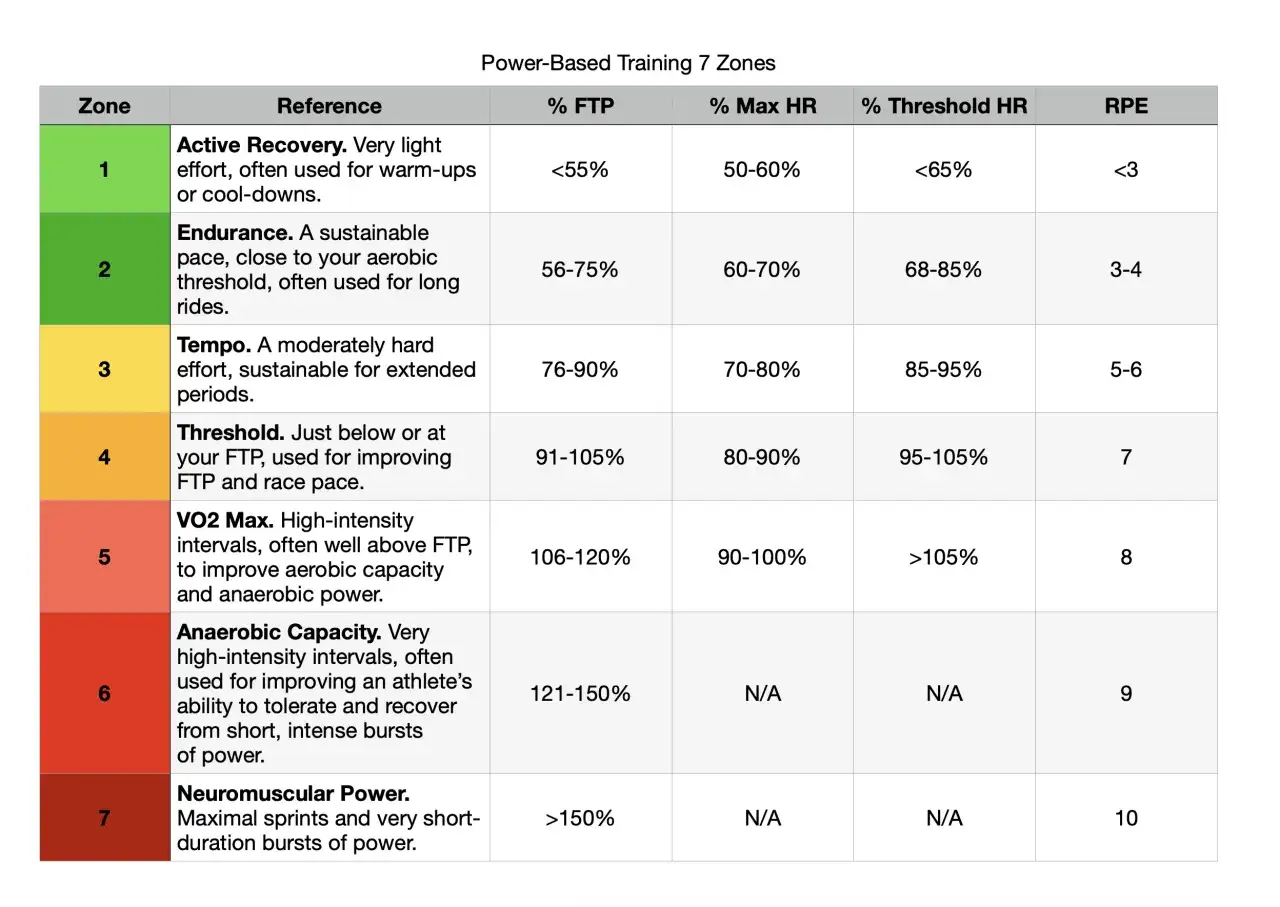
The seven-zone split below is the version I reach for most often because it gives enough detail to guide real training without becoming fussy. Some apps compress this into five zones, but the physiology does not change just because the labels do. I care less about the color on the screen and more about whether the session is targeting the right adaptation.
| Zone | % of FTP | Main purpose | What it should feel like |
|---|---|---|---|
| Active recovery | <55% | Recover between intervals or after hard days | Very easy spinning, almost no burn in the legs |
| Endurance | 55-75% | Build aerobic base, efficiency, and durability | Steady and conversational, even on longer rides |
| Tempo | 76-87% | Useful aerobic work when you want more stress than zone 2 | Solid pressure, controlled breathing, manageable for long blocks |
| Sweet spot | 88-94% | High-value fitness gains when time is limited | Hard but sustainable in intervals; it asks for focus |
| Threshold | 95-105% | Raise sustained race power and lactate tolerance | Uncomfortable, precise, mentally taxing, but repeatable |
| VO2 max | 106-120% | Lift the aerobic ceiling and improve short hard efforts | Breathing gets heavy fast; intervals are short and sharp |
| Anaerobic capacity | >120% | Repeated surges, accelerations, and punch | Very hard, very short, with recovery becoming critical |
The ranges are guide rails, not handcuffs. On a hot day, after a bad night's sleep, or during a windy outdoor ride, perceived effort can move faster than the power numbers do. That is where RPE, or rate of perceived exertion, earns its keep: it tells you whether the body is actually matching the target, not just the file on the head unit. Once that map is clear, the next question is simple: which zone should you choose for the outcome you want?
Which zone I’d pick for the job
The mistake I see most often is turning every ride into a vaguely medium-hard ride. That feels productive, but it usually spreads the stress too thin. I want each ride to have a clear job, and the table below shows how I think about that job when I am planning a week.
| Training goal | Best zone or zones | Example session | Why it works |
|---|---|---|---|
| Build a strong aerobic base | Endurance | 90 to 180 minutes steady, sometimes longer | Lets you accumulate volume without burying recovery |
| Get a lot done in limited time | Sweet spot | 2 x 20 minutes or 3 x 12 minutes | High aerobic stimulus with less recovery cost than threshold |
| Raise sustained race power | Threshold | 3 x 10 minutes, 4 x 8 minutes, or over-unders | Teaches you to hold near-maximal steady power under pressure |
| Improve the top end of your aerobic engine | VO2 max | 5 x 4 minutes or 6 x 3 minutes | Pushes oxygen use and makes hard efforts more repeatable |
| Handle surges and attacks | Anaerobic capacity | 8 x 30 seconds or 10 x 1 minute | Builds punch, acceleration, and short-duration repeatability |
For most amateur cyclists, I think the best balance is still simple: plenty of endurance, one focused hard session, and maybe a second intensity day if recovery is holding up. Sweet spot is not magic, but it is efficient because it lets you spend more time close to threshold without paying the full price of threshold work every day. That is also why zone 2 still matters so much; it gives you the volume you can actually absorb. The next step is making sure the FTP number behind all of this is worth trusting.
How to set FTP so the zones are worth trusting
A beautiful zone chart is useless if the anchor is wrong. In practice, I want FTP set in a way that matches the rider's current fitness and can be repeated consistently. The exact test matters less than the discipline around it: same bike setup, similar conditions, honest pacing, and a fresh enough body to produce a believable result.
| Test type | Best for | Strengths | Limitations |
|---|---|---|---|
| 20-minute test | Riders who pace well and want a familiar field test | Simple, widely used, close to real-world steady effort | Bad pacing can skew the result, especially for strong sprinters |
| Ramp test | Quick updates and busy training blocks | Fast, low setup, easy to repeat often | Can miss riders whose strength profile is unusual |
| Long steady effort | Riders who can hold a controlled pace for a long time | Very specific to endurance riding and pacing skill | Harder to execute and more draining to recover from |
I usually want riders to reassess FTP every 4 to 6 weeks during a structured build, or sooner after illness, a break, or a clear fitness jump. If workouts start feeling strangely easy, or threshold work turns into survival too soon, the number is probably stale. That is not a sign that the plan is broken; it usually means the plan needs a fresh calibration. Once that calibration is right, the next problem is much more ordinary and much more important: the mistakes that slowly erode the value of good zones.
The mistakes that make power zones miss the mark
Most training failures here are boring, which is exactly why they happen. Nobody plans to waste a week, but plenty of riders drift into habits that make the numbers look precise while the training effect gets fuzzy.
- Using an old FTP - if your fitness has moved, every zone target has moved with it.
- Living in the middle - too much tempo and sweet spot can create fatigue without enough contrast between easy and hard days.
- Ignoring fatigue and heat - power may hold while the body is already under more stress than the file suggests.
- Riding every session by watts alone - RPE and breathing tell you when the number is believable and when it is not.
- Chasing more intensity instead of better structure - one focused threshold or VO2 session often beats three half-baked hard rides.
The fix is usually simple: update the anchor, separate easy from hard more cleanly, and keep the goal of each workout obvious. Once that is in place, a weekly template becomes much easier to execute, even on a busy schedule or a travel-heavy week.
A realistic week built around FTP-based training
If I were building a practical week for a rider with 6 to 8 hours available, I would keep the shape boring on purpose. The point is not to hit every zone every week; the point is to make the right zones show up often enough to drive adaptation without burying recovery.
| Day | Session | Zone focus | Purpose |
|---|---|---|---|
| Monday | Rest or 30-45 minutes very easy | Active recovery | Absorb the previous week and arrive fresh |
| Tuesday | 3 x 12 minutes | Sweet spot | Efficient aerobic overload with manageable fatigue |
| Wednesday | 60-90 minutes steady ride | Endurance | Build volume and keep the aerobic system busy |
| Thursday | 4 x 8 minutes or 5 x 4 minutes | Threshold or VO2 max | Target sustained power or the aerobic ceiling |
| Friday | Rest or easy spin | Active recovery | Lower accumulated stress before the weekend |
| Saturday | 2 to 4 hours steady, with a few tempo climbs if needed | Endurance and tempo | Practice fueling, pacing, and late-ride durability |
| Sunday | Easy endurance or off | Endurance | Add volume without turning the weekend into a race |
If the week shrinks because of work, travel, or weather, I keep the key workout and the long ride, then trim the filler. That rule saves more progress than trying to make every indoor spin session count. The same idea applies when you are traveling in the US or riding away from home: protect the sessions that matter, keep the easy rides truly easy, and do not let convenience turn into constant moderate effort. That is the cleanest bridge to the last thing I want you to keep in mind.
What I’d focus on if I wanted better results fast
If I had to reduce the whole system to one coaching note, it would be this: keep FTP current, spend a lot of time in endurance, and make the hard sessions unmistakably hard. That sounds basic because it is basic, but basic is usually what works when training needs to fit around work, family, travel, and the real constraints of a normal week.
Power zones are best used as guardrails, not a scoreboard. When the anchor is current and the session matches the job, the plan gets simpler, recovery gets easier to manage, and progress becomes much easier to read. If you apply that consistently, the numbers stop feeling abstract and start becoming useful on the road, on the trainer, and in the kind of rides that actually define your season.